Order:Zygentoma (formerly Thysanura)
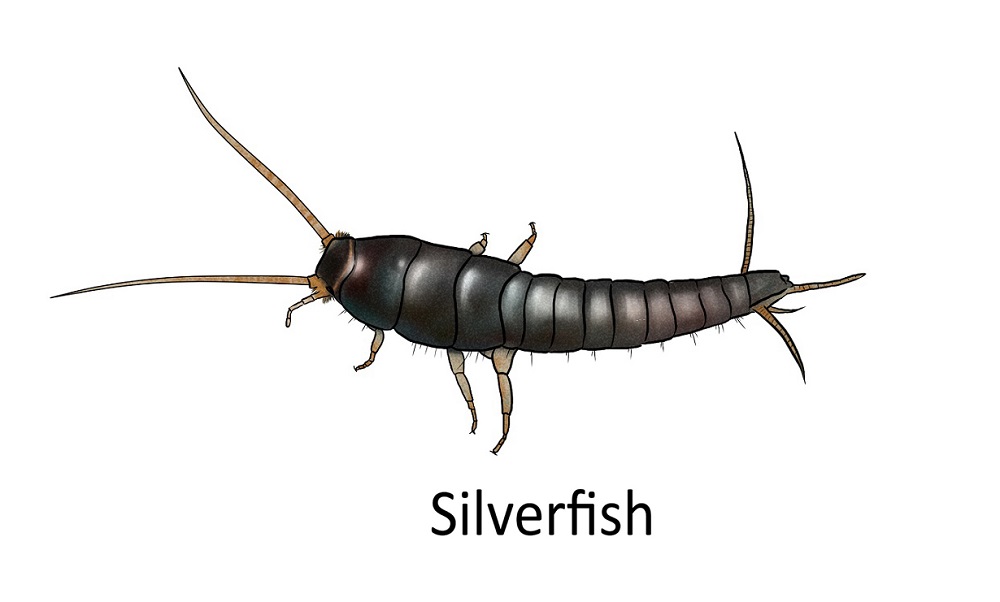
Silverfish
This small order consists of the most ancient insects and is the only insect that is primitively wingless, meaning that never possessed wings, unlike most wingless insects that we know today where their absence of wings is due to evolution. There are about 370 species of silverfish worldwide divided into only four families. In Australia there are 28 species present. Type of metamorphosis: Primitive
Appearance
Silverfish are dorsally flattened and more species are covered in tiny scaled.
Wings: Absent/ Primitively wingless
Mouthparts: Chewing
Antennae: Medium to long, thread-like
They have three long abdominal appendages; a pait of cerci and an appendix dorsalis.
Biology and Behaviour
In their natural habitat, silverfish can be fond beneath barn and in areas such as soil, leaf litter, and decomposing logs. They are nocturnal and prefer hiding during the day and become more active at night when they look for food. While they have omnivorous tendencies, they prefer plant materials rich in starches and proteins. Silverfish are fast and agile, and their sclares that are easily detachable likely function as a mechanism to evade predators.
The mating process of the silverfish happens quickly. They perform a marting dance that involves the male and female tapping each other with their antennae. The male spins a Y-shaped silk structure then deposits a sperm capsule (spermatophore) on the surface. The female detects the silk spun by the male and takes up the sperm capsule into her ovipositor. The eggs are laid singly or in clusters of sever to twelve, but females can lay no more than 30 eggs at a time. Eggs can hatch under 20 days if the temperature is around 32℃. Because silverfish have a primitive metamorphosis, the young are almost look exactly the same as the adults but smaller. The immatures undergo a number of moults within 3-24 months. After reaching adulthood they continue to moult throughout their life, which can be as long as four years.
Pest Status
There are five species of silverfish in Australia that have exploited buildings, frequently consuming books, paper, and clothing. They particularly target the starchy glues and sizing paper in these objects. They are usually found in cabinets, wardrobes, roof voids, and boxes of books, and filed papers. They do not transmit any diseases.