Ticks are parasitic arachnids that belong to the subclass Acari (or Acarina). Unlike spiders, with two distinct body regions, their cephalothorax and abdomen and wholly fused. They have four pairs of legs in the adult stage and three pairs of legs in the immature stages. Ticks are external parasites that feed on the blood of mammals and sometimes reptiles and amphibians. They can cause death by introducing toxins into the bloodstream, or cause non-fatal infections.
Life Cycle
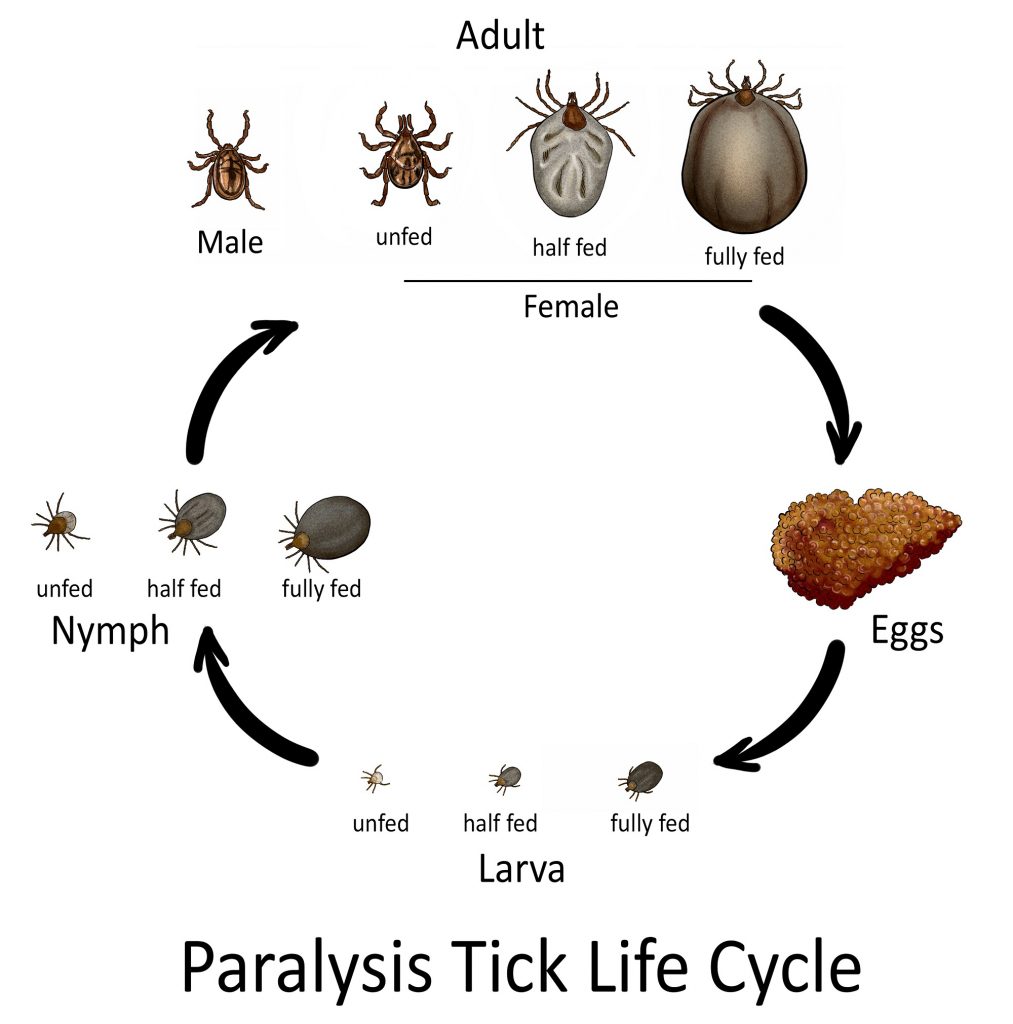
Ticks go through four life stages— egg, larva, nymph, and adult. After hatching from the eggs, the larvae must eat a blood meal to grow and move on to the next life stage. Female ticks need a blood meal in order to produce eggs, while males do not feed on blood and do not attach themselves to warm-blooded hosts. The life cycle lasts 2–3 years; most will die because they cannot find a host.
Egg. A female tick completes its life cycle after laying up to 3,000 eggs, typically during spring. The eggs are usually found in warm and moist areas that have contact with the ground such as leaf litter, under bark, and debris.
Larva. After two weeks to two months, depending on temperature and humidity, the eggs hatch into larvae. They are about 1.0–2.0 mm and have six legs. After their skin hardens, they climb onto foliage and attach themselves to small animals to get a blood meal. After feeding for 4–6 days, the larva falls from the host onto the ground to moult into a nymph.
Nymph. It measures about 1.0–5.0 mm and has 8 legs. It may remain in moist vegetation for 4–10 days before attaching to another animal. Once it attaches itself, it feeds for 4–7 days and then drops to the ground to moult and then emerges as an adult.
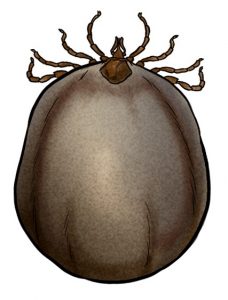
Adult. The adult female is 5.0–6.0 mm long and after a short period attaches itself again to a host. It usually feeds for up to 6–20 days. A fully-fed female is about 10 mm long.
Important Tick Species
Australian Paralysis Tick
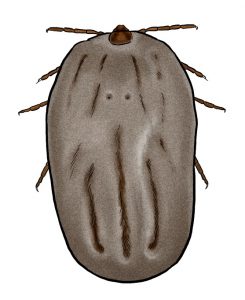
Brown Dog Tick
Tick Poisoning
When the tick finds a host and locates a feeding spot, it grips the skin and cuts into the surface. It attaches itself by inserting its mouthparts (hypostome), which have barbs like that of a fishhook, that point back toward the tick— a feature that makes the tick hard to remove without damaging the skin. It then injects an anticoagulant with other active substances from the salivary gland that causes the mouthparts to become clogged. It is this anticoagulant, with other pharmacologically active substances, that is toxic to animals.
Symptoms and treatment of tick bites
These symptoms start to appear 3–7 days after a tick has attached itself to an animal:
- Appetite loss and lethargy.
- Discharge from eyes may be present.
- Difficulty in walking and coordinating movements, especially in the back legs.
- Dilated pupils
- Vomiting
- Heavy breathing and wheezing.
- Paralysis extended to the forequarters, with difficulty in swallowing and breathing.
- Death may be caused by respiratory failure because of paralysis of the throat region; heart failure may occur.
If a tick is located on an animal, it must be brought to a veterinary clinic as soon as possible. The tick should be removed by using clean pointy tweezers or forceps to grasp the tick head area. Pull firmly and steadily until the tick lets go of the skin. Do not squeeze the tick’s body; either send it for testing or get rid of it by drowning it in rubbing alcohol or soapy water, or flushing it down the toilet/drain. Clean the bite area with rubbing alcohol or soap and water.
Prevention of ticks
The risk of ticks in an area may be prevented by doing the following:
- Check pets regularly for ticks, especially when they went outside.
- Use veterinary-approved products for ticks on pets.
- Regularly clean and vacuum kennels.
- Reduce vegetation and keep turfed areas regularly mown.
- Reduce leaf litter and debris near the home.
- Prevent and control rodents and bandicoots around the home.
- When gardening or trekking, use approved products that can repel ticks. Also, wear the proper attire – a cap, long pants, long socks, long sleeves, and closed-in shoes.
- After visiting high-risk tick areas, check the body, clothes, and bedding for ticks.