Scientific name: Latrodectus hasselti
Other common name: Australian black widow
Distribution
Can be found all over Australia
Type
Tangle-web/cob-web
Family
Theridiidae
Identification
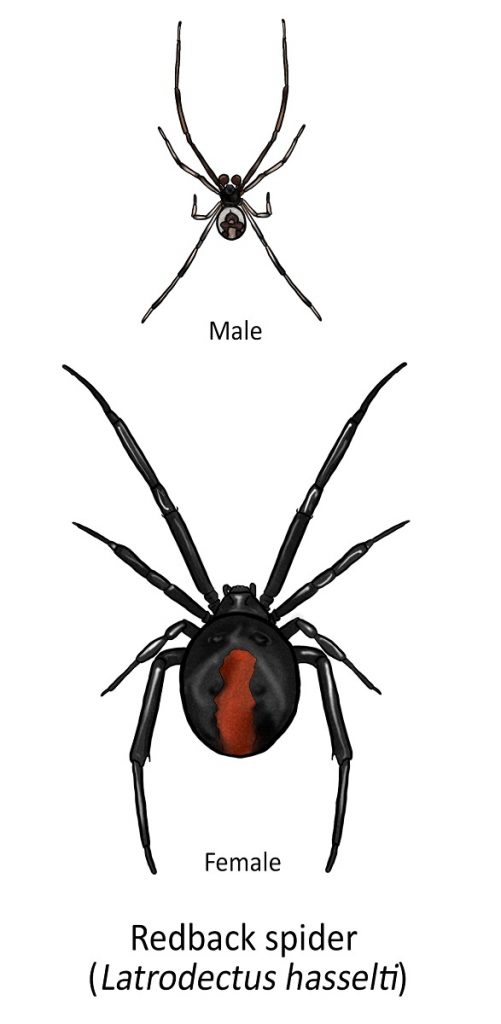
Females are 12–15 mm and males are 3–4 mm. Females are shiny and black, with an orange to the red stripe on the abdomen. Their underside has a red stripe shaped like an hourglass. In males, the light markings are less distinct.
Life Cycle
1 generation per year.
Behaviour
They are nocturnal. Females mostly stay in their nests during the day and they spin their nests during the night. Their webs look very irregular and tangled but are actually strategically placed for catching prey. The upper portion of the web forms a funnel-like retreat area where the spider hides itself and her eggs. They build their nests around buildings, outside window frames, and in piles of rocks or wood.
Safety Risk
Very toxic. The females bite but the males do not. Bites are very painful.
General Treatment Procedures
Gaining Access
Residential
You must notify the customer beforehand that you are scheduled to do a pest control treatment via phone call or otherwise before you proceed to the property. You must either knock on the front door and ring the doorbell or otherwise, to alert the client that you have arrived on site. If a minor answers the door or intercom, ask to speak to an adult occupant.
Introduce yourself to the occupant and explain the work order, confirm the client’s request, and ask about the pest problem using a friendly and professional tone.
You must use the following introduction or something similar:
“Good morning Mr/Ms [Occupier’s last name] my name is [Your name] I am here to treat [inspect] your home for [pests included in the job allocation]. Is there anything, in particular, you want me to pay attention to?”
Commercial
You must contact the authorised person at the business and notify them that you are scheduled to do a pest control treatment via phone call or otherwise before you proceed to the property.
Introduce yourself to the authorised person and explain the work order, confirm the client’s request. Use the following introduction or something similar:
“Good morning Mr/Ms [Authorised person’s last name] my name is [Your name] I am here to treat [inspect] your home for [pests included in the job allocation]. Is there anything in particular you want me to pay attention to?”
Describing the Job
Before starting the job, the Pest Controller must:
- Inform the client about treatment details.
- Inform the customer about the equipment, products, and in what areas you intend to use them.
- Ask if the client has any health risks, e.g. asthma.
- Inform the client of the treatment preparations, e.g. the windows need to be closed, and children and pets should be excluded from any area until any pesticide solution has dried and the room has been ventilated, etc.
- Inform the customer that they must leave the premises during the treatment.
- Explain the Spider warranty.
- Confirm the approval of the client to proceed.
Conducting A Site Risk Assessment
Some elements to consider before doing a treatment include:
- People
- Children
- Pets (dog/s, cat/s, caged birds)
- Fish tanks/fish pond
- Other animals or pets
- Clothes on line
- Electrical wiring or outlets that can lead to electrical shocks
- Health risks (asthma or respiratory risks)
- Slips and trips
- Temperature
- Spills
- Working at heights
- And other potential risks
Examples of risk and safety considerations you must do before treatment include:
- Exclude occupants, children, and pets for the duration of the treatments
- Secure pets and make sure they can not escape
- Remove or turn over any pet food or water containers
- Cover fish ponds
- Keep a spill kit on site
- Ensure the ladder is safe to use
- Wear the necessary PPE
Inspection
Before conducting an inspection, wear long sleeves and long gloves to guard against spider bites.
Internal
- Use a torch to inspect stored boxes, cabinets, behind and under appliances and furniture, and other undisturbed areas.
- Keep on the lookout for cobwebs, as they are a clear indication that spiders have been present.
- Be alert, as spiders will move quickly once they sense your presence.
External
- Pay closer attention to the foundation of the structure, especially where there is landscaping.
- Pay special attention to eaves, cracks, crevices, and corners.
- Check for spiderwebs.
- Check electrical boxes and other protected areas.
You should also be on the lookout for other pests, as spiders eat insects like cockroaches, flies, etc.; they might be attracting spiders in the home.
Non-chemical Control
- Regularly trim down vegetation that overhangs or makes contact with the building.
- Vacuum regularly to minimize spiders and spiderwebs, and other bugs that serve as spider food.
- Block entry points, install screens if the doors and windows are left open frequently, and patch holes and cracks in the foundation if there are any.
- Declutter the outside perimeter of the structure; get rid of woodpiles where redbacks can nest in.
- Declutter rooms inside the structure to reduce hiding places for spiders.
- Clean leftover food and other kitchen spills immediately.
Chemical Control
External treatment
- Mix the required amount of Spider Spray Solution.
- You must only use a product listed in the Pesticide list as an approved Spider Spray product.
- Ensure Your Equipment is in good working order.
- Using either a 6502 or a 6504 fanjet tip apply spray solution to the entire external perimeter wall surface, eaves, gutters and downpipes to height of at least 3 metres.
- Spray to the ‘point of run off’
- Ensure the fan spray orientation is vertical when spraying brick surface.
- Use the angle of the fan to spray into areas obstructed by, downpipes, gutters, eaves, fixtures and stored items.
- Use the angle of the fan jet to spray around windows and door frames to achieve a adequate coverage without excessive overspray
- Check and spray, if necessary, any trees close to the dwelling for ‘orb weaving spiders’ or other webbing spiders.
- Pay special attention to garage doors for redback spiders.
- Inspect external children’s play equipment and spot treat.
- Areas above 3 meters may be accessed with an extension wand or a cone jet
- Inspect and spray letter-box and accessible fences.
- Where it is unsafe or in your reasonable opinion not appropriate to apply Spider Spray you must notify us of the reason[s] why within 24 hours and arrange to return to the Site and complete the Spider Spray when it is safe and in your reasonable opinion appropriate.
- You must not Complete the Job until either:
- the Spider Spray has been carried out; or
- You have received written authorization from Us authorizing you to Complete the Job.
Internal treatment
- You must apply Dust to all Accessible roof areas
- You must only apply Dust listed in Pesticide list as an Approved Dust
- If you remove an electrical appliance lead in order to connect the Dusting Machine you must reconnect the appliance immediately after You have finished applying dust to the roof void.
- You must use a ladder to remove the access point (manhole) cover.
- You must use a torch to inspect the roof void before applying Dust to the roof void.
- Using the Dusting Machine’s dust/air mixture control and the extension wands you must apply an even distribution of dust to the entire roof void.
- If it is not possible to apply an even distribution of Dust from the manhole You must enter the roof void to complete the operation.
- If You enter the roof void You must not allow any component of the roof to bear of any significant portion of Your body weight that is not either:
- a part of a truss; or
- a substantial roof support (obviously capable of supporting the weight of Your body) .
- If there is no access to the roof void or it is unsafe to access the roof void you must notify us when you Complete the Job.
- If the access to the roof void is obstructed you must within 24 hours and you must make reasonable efforts to return to Apply Dust to the roof void.
- Where access is obstructed You must not Complete the Job until either:
- Dust has been applied to the roof void; or
You have received written authorisation from us to Complete the Job.
Restore the Site
Once you are done treating the area, you must restore it to its original condition. Anything that was moved due to risk assessment, or to gain access to a harbourage should be placed back to where it was e.g. pet’s water bowls should be replaced, replace toaster or microwave if it was moved, any electrical appliances that were removed to use the dusting machine should immediately be reconnected, etc.
Completing documents, Re-entry time, and Post Treatment Expectation
After the treatment, talk to the client and discuss the terms and conditions and the invoice incompletion. You must ensure to discuss when the occupants can re-enter the treated rooms and ventilate the house to allow fresh air to circulate and remove any lingering odour or fumes from the chemicals.
You must discuss what to expect after the treatment. For example, you must explain that the occupants might notice that there is an increase in pest activity after the treatment, which is normal because the pests were flushed out from hiding spots; the cockroach activity should decrease within the first 2 weeks, then over the following weeks. You should also explain the mode of action of the products you used to assure the customer that the treatment will work.
Clean & tidy up
Clean all equipment used during the treatment immediately after use, as dried pesticides are harder to clean. Clean the equipment away from water supplies and children and animals, also check the pesticide label to know how to properly dispose of and store them. Wash and clean your PPE immediately after use. Return all items such as sprayers, warning signs, etc. to the vehicle, and correctly store PPE. Be sure to wash any parts of the body that may have been exposed to the pesticides with soap and water.
Leave a Reply