Nasutitermes gravelous
Distribution
Can be found in the Northern Territory; Cairns district, Atherthos Tableland, Ravenshoe, Herberton, El Arish, Dunk Island, Palm Island, Magnetic Island, Townsville, Cape River, and Yarwun in Queensland.
Identification
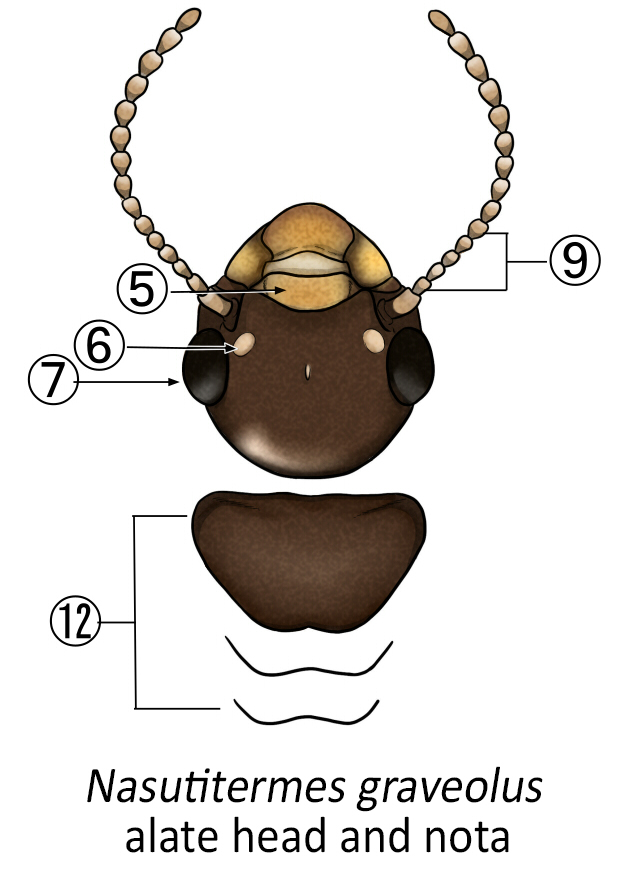
Alates. Alates are rather large, measuring 15.00-15.75 mm with wings, and 7.50–8.00mm without wings
- Head dark brown
- Thorax and legs very light brown
- Antennae very light brown
- Topside of abdomen darker than pronotum
- Postclypeus less than half as long as it is wide
- Ocelli oval, less than their width from eyes
- Eyes very large and prominent
- Antennae 15 segments
- 2nd–5th segments variable; 2nd usually as long as 3rd, sometimes shorter than 3rd; 4th and 5th usually shorters of all; 5th sometimes longer than 6th segment.
- First and second teeth of the left mandible are equal in size
- 2nd tooth of the right mandible is as long as, but wider than 1st tooth
- Pro-, meso- and metanotum margins as in figure
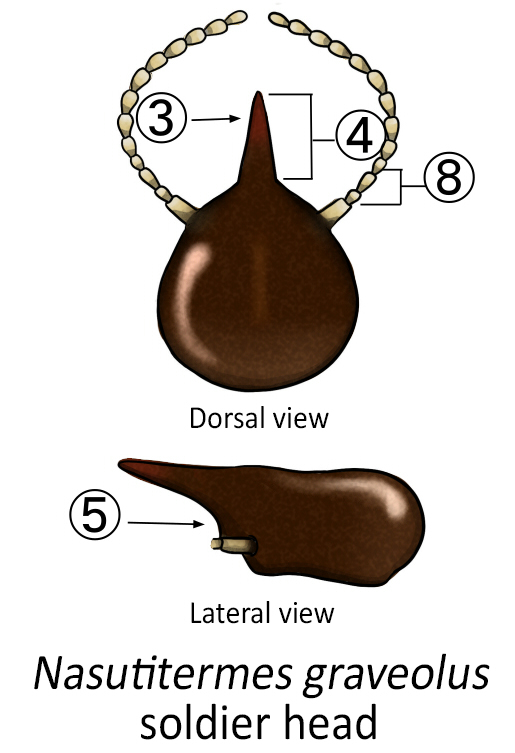
Soldiers. Soldiers are 4.00–4.50 mm in length, a medium size species with short wide heads, and short antennae
- Head is very dark brown, the posterior part is the palest, and has a few long fine hairs
- Head with a pale median line
- Anterior half of snout is reddish-brown
- Snout is short, about half as long as the remainder of the head
- Head convex above the insection of antenna
- Abdomen more hairy than head; hairs unequal lengths
- Antenna 13 segments
- 2nd-4th segments are variable; 3rd antennal segment noticeably longer than 2nd and 4th segment
- Sometimes 3rd antennal segment is shorter than all other segments and the 4th segment is a little longer; 5th segment a little longer than 3rd
- Mandibles are well-pointed
Workers. Workers are 4.50–5.00 mm in length
- Head is mostly chestnut brown with numerous hairs of unequal lengths
- Postclyeus dark buff in colour, and a little less than half as long as it is wide
- Antennae of 14 segments, 3rd segment noticeably longer than 2nd and 4th segments; 4th usually shorter than 2nd segment
Habitat and Behaviour
This species makes arboreal nests that are more or less spherical in shape about 30–40 cm in diameter. The nests are dark brown and made up of carton material. The exterior is thin and brittle, rough, and has many horizontal ridges. The nests are located on top of a tree and are connected to the ground by mud tubes. This species can damage fence posts and transmission poles but does not make any significant economic damage since its activity is easily detected by its nesting habits.
Leave a Reply