Nasutitermes exitiosus
Distribution
Occurs throughout southern Australia, from southern Queensland to south-west Australia. Absent in some areas of eastern Victoria and the northern rivers district of New South Wales.
Identification
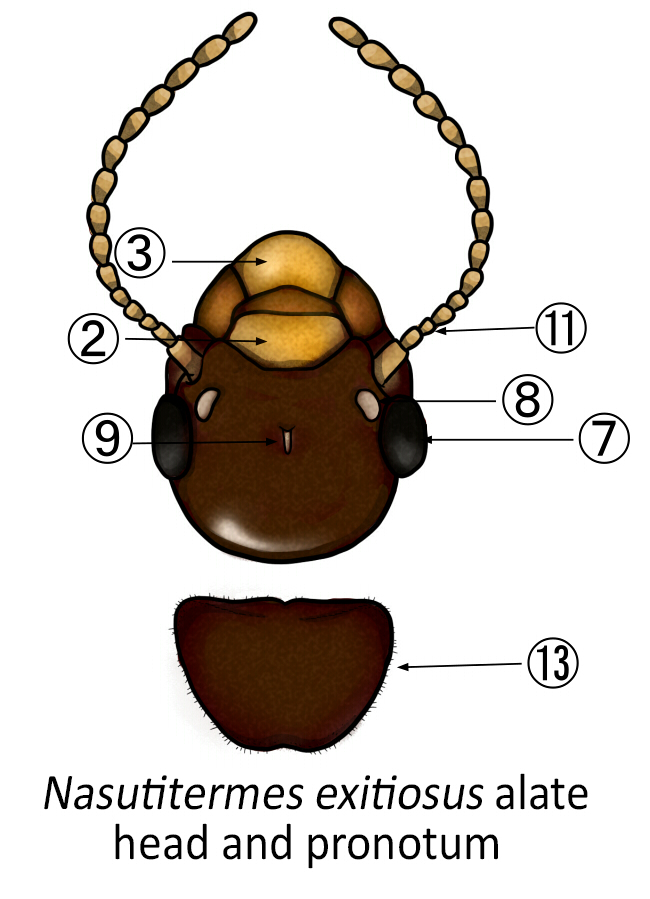
Alates. Winged adults measure 15.50–17.50 mm with wings, and 6.50–8.50 mm without wings.
- Head very hairy, dark chestnut brown in colour
- Postclypeus yellow ochre to clay in colour, and a little less than half as long as wide
- Labrum yellow ochre to clay in colour
- Antennae yellow ochre to clay in colour
- Thorax , legs, and underside yellow ochre to clay in colour
- Wings are mummy brown in colour
- Eyes are large
- Ocelli are large and close to eyes
- Fontanelle is linear and forked anteriorly
- Antennae has 15 segments
- 2nd segment of antenna shortest of among all
- First and second teeth of mandibles are approximately equal in size
- Pronotum a little narrower than head, very hairy, and have slightly curved anterior and posterior margins
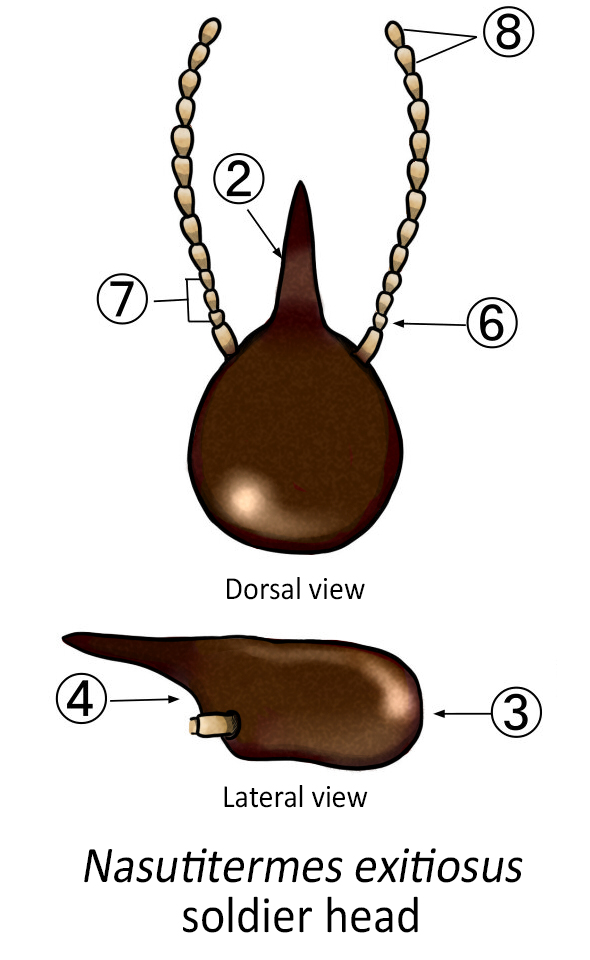
Soldiers. Soldiers are 3.75–4.75mm in length, small to medium size.
- Head with very few hairs, and dark chestnut brown in colour
- Entire rostrum or snout darker than head, or only the base and tip are darker
- Posterior half of head hemisperical, gradually narrows to the snout
- Head convex above insertion of antenna
- Antennae has 13 segments
- 2nd antennal segment shortest of all,
- 3rd antennal segment usually longer than 2nd and 4th segment
- 13th antennal segment shorter and narrower than 12th
- Pointed mandibles
Workers. Workers are 4.25–4.55 mm in length
- Head light yellowish-brown in colour, with two broad cinnamon brown bands on each side of the median line
- Postclypeus and labrum antimony yellow
- Antennae 14 segments
- 3rd antennal segment always longer than 2nd and 4th segments
- Postclypeus a little more than half as long as wide
Habitat and Behaviour
N. exitiosus builds low mounds about 30–75 m in height and 30–120 m in basal diameter. The exterior of the nests is made up of earthy materials about 8 cm thick and the interior is name up of a tough woody wall about 12–15 cm thick. Nests can be found under buildings, and when left undetected can cause severe damage.
The species attacks almost entirely sound wood that has contact with the ground such as poles, fence posts, bridges, and buildings. N. exitiosus has a preference for hardwood timbers, particularly sapwood and not so much for pine timbers.
The mound-building behaviour of this species aids in identifying termite activity before severe damage is done to wooden structures.
Leave a Reply