Nasutitermes fumigatus
Distribution
Brisbane along the eastern coast of Australia and around the southern coastal areas to Adelaide
Identification
Alate: 10.00–12.00 mm in length with wings; 5.00–6.00 in length without wings.
- A small species; variable in colour from light brown to moderately dark brown.
- Wings are brown in colour with a distinct translucent area in the basal half of the wing between the median and cubitus, with very dark veins. Cubitus with 12 to 15 branches.
- Head, thorax, and abdomen are very hairy.
- Pronotum is small and narrower than head; sides are broadly rounded.
- Fontanelle is large and distinct.
- Postclypeus is a little shorter than half its width.
- Eyes are pigmented and variable in size.
- Ocelli are broadly oval and widely separated from the eyes.
- First and second teeth of mandibles are equal in size.
- Antennae have 15 segments.
Worker: 3.25–3.50 mm in length.
- Head is orange-yellow in colour, posterior half suffused with light brown and has a few reddish hairs.
- Antennae of 14 segments; 4th segment the shortest.
- Postclypeus a little more than half as long as wide.
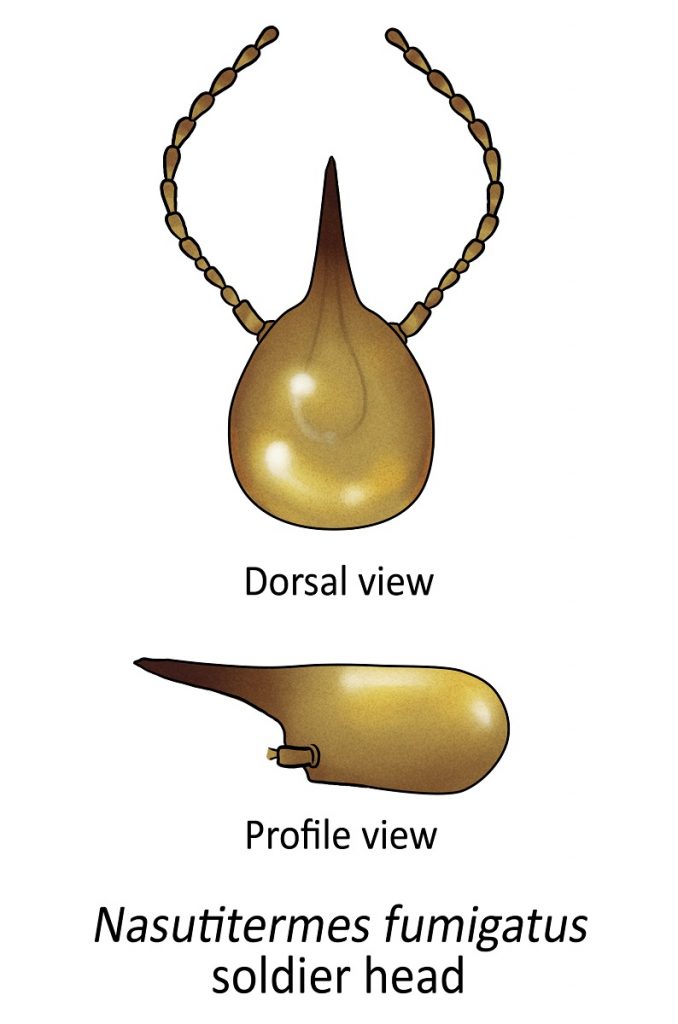
Soldier: 3.25–3.75 mm in length; small.
- Pale-coloured head— light orange-yellow, sometimes suffused with light brown. Head has very few hairs.
- Rostrum is long and light reddish brown in colour.
- Antennae darker orange than yellow.
- Palpi and the top surface of abdomen are paler than antennae.
- Antennae usually 13 segments, 4th segment usually the shortest of all.
- Mandibles usually with points.
Habitat and Behaviour
Small colonies are found under stones or rotten logs, in the sapwood of poles, fence posts and house piers, in rotten wood in living trees, in mounds of other termite species, and occasionally in mud tubes on surfaces of wood.
This species is not economically important in Southern Australia.