Nasutitermes dixoni
Distribution
Occurs southward from Coffs Harbour along the eastern coast of New South Wales and around the southern coastal area to South Australia.
Identification
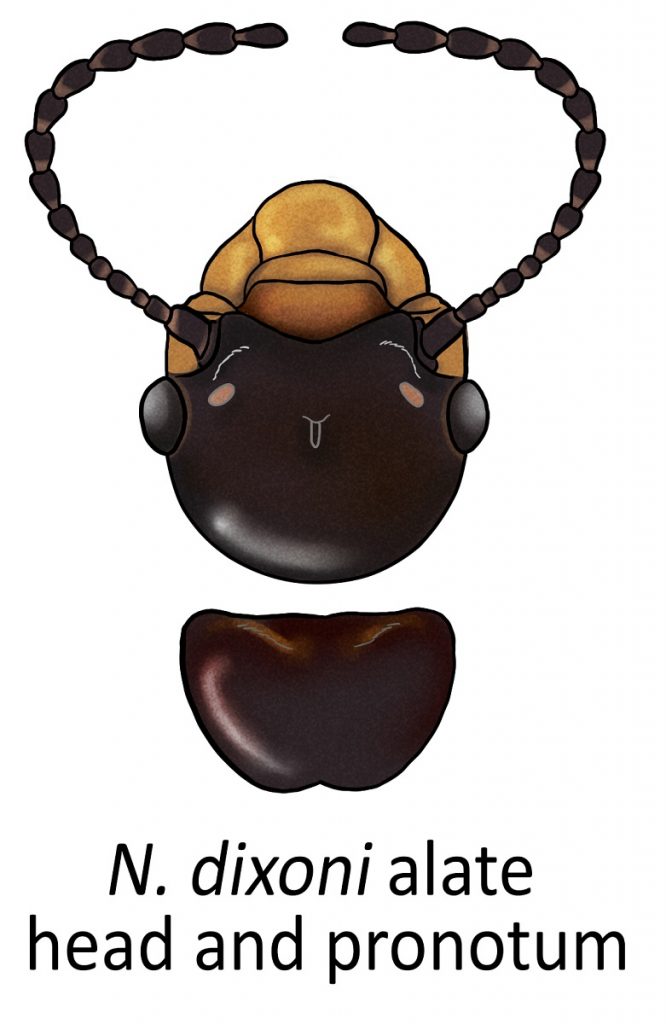
Alate: 14–15.50 mm long with wings; 5.50–6.60 mm without wings.
- Small, and very dark brown; intermediate in size between N. fumigatus and N. exitiosus (two species have almost the same distribution as N. dixoni)
- Head, antennae, pronotum and the top surface of the abdomen are darkest in colour.
- Postclypeus is yellowish and suffused with brown.
- Wings are dark brown, usually with a translucent area in the basal half of the wing between the median and cubitus, with very dark veins.
- Postclypeus less than half as long as wide.
- The first and second teeth of mandibles are equal in size
- Fontanelle is usually indistinct.
- Antennae are 15 segments; the 3rd sediment is the smallest; 4th and 6th segments are larger than the 5th.
Worker: 4.25 mm in length.
- Head mostly yellow above, light brown posteriorly.
- Clypeus is paler than head.
- Antennae have 14 segments; segmentation is variable but 4th segment is usually the shortest.
- Postclypeus less than half as long as wide.
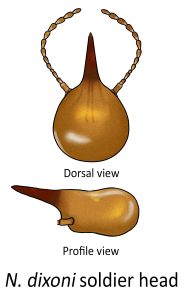
Soldier: 3.50–4.00 mm in length; small.
- Head is yellowish with few hairs. The posterior part is the palest.
- Rostrum or “snout” is moderately stout at the base, sometimes very stout. It is reddish-brown to orange at the base.
- Antennae usually have 13 segments, rarely 12 or 14 segments. 4th segment is usually the shortest, and sometimes the 3rd segment is the shortest.
Habitat and Behaviour
The habits of this species are very common to N. fumigatus, but the colonies are larger and occur more frequently in moist and sheltered areas. It also nests in the decayed heart of living and dead Eucalyptus trees.