Praying Mantids
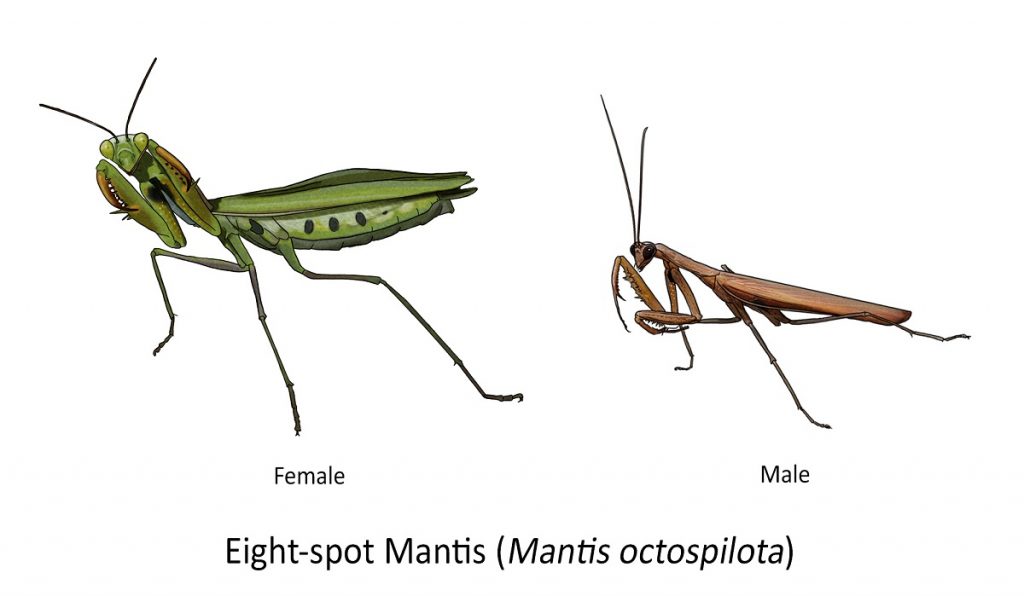
There are over 2,400 species of praying mantis in the world, 118 of which are in Australia.
Mantids are easily recognised through their distinctive “praying” stance, which they do in their ‘sit and wait’ predatory behaviour. The remarkable precision with which they capture their prey, together with the notorious tendency of some female mantid species to eat their male partner during mating, undoubtedly earns these insects a reputation as the “ultimate predators” in the insect world.
Morphology
Adults are medium to large in size and are adapted for predation. They have triangular heads with chewing mouthparts on a slender neck. They have well developed compound eyes, ocelli are usually in threes but may or may not be present. The prothorax is long and narrow and the antennae are thread-like and usually shorter than body length. Their forelegs are modified for grasping prey, with long sharp spines for holding what they catch. They have two pairs of hindlegs used for walking.
In winged species, the forewings (tegmina) are somewhat thickened to cover the membranos hindwings. In most Australian species, the males have functional wings, but reduced or absent in females.
The nymphs are similar to adults except for wings and genital development.
Biology and Behaviour
These insects live solitarily, often in vegetation, patiently ambushing prey like insects and spiders. They’re skilled at camouflaging as “sit and wait” predators. Mating involves a courtship ritual. In some species that exhibit sexual cannibalism, the females sometimes come the male afterwards. Before laying eggs in batched of ten to several hundred, the female secretes a protective forty material. After hatching, the nymphs moult and adopt predatory habits like the adults.
Pest Status
Mantids are not pest, as they are predators and may even be regarded as beneficial insects.