Butterflies and moths
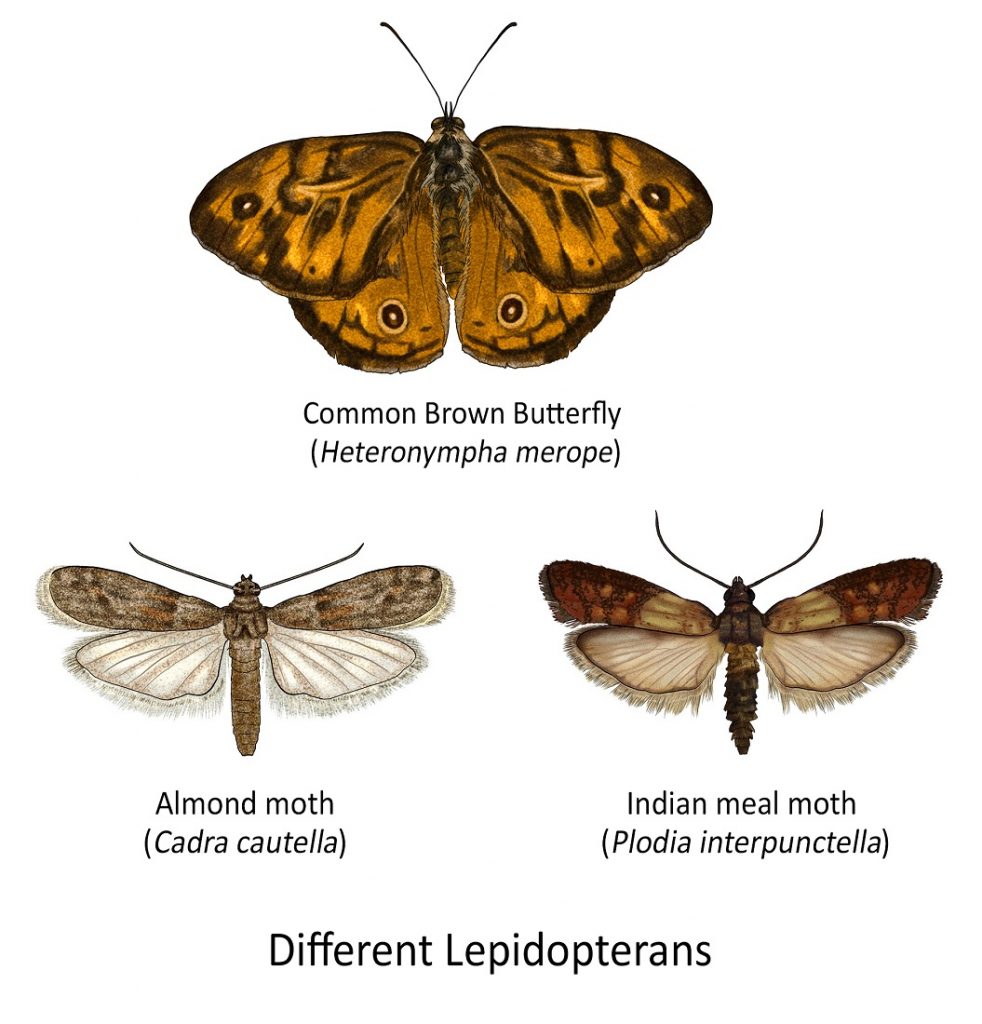
There are about 180,000 species of lepidopterans worldwide, approximately 30,000 are present in Australia.
This group of insects is widely admired of its beauty and grace, but the gluttenous appetites of their larvae can lead to them being perceived as pests in agriculture and horticulture sectors and homeowners.
Appearance
Adults vary in size from small to very large. While a few lack wings, most have two pairs of wings covered in scales that are often subtly or brilliantly coloured. The forewings are typically larger, and there is usually a coupling mechanism. Compound eyes are well-developed in most cases, and ocelli may be present. Antennae are relatively large and variable. Legs are adapted for walking. The mouthparts, in the form of a coiled tube, are distinct. When uncoiled, the tube or proboscis serves as a drinking straw for available liquids.
Larvae are often called caterpillars. They have sclerotized head capsules, chewing mouthparts, thoracic legs, and often five pairs of abdominal prolegs. The caterpillar may be smooth or hairy, featuring fleshy spines, urticating hairs, or tubercles.
Biology and Behaviour
Moths and butterflies, with brief adult lifespans, primarily consume liquids like nectar. Sexual reproduction involves attraction through flight patterns and scents, with copulation on surfaces and egg-laying in larval feeding areas. The majority of larvae feed on plants, some as leaf eaters, leaf miners or borers. Silk production is common for protection. Larvae, mostly solitary, pupate in soil or on a host plant. Pupae are usually protected in a cocoon for moths and chrysalis for butterflies.
Pest Status
Many lepidopterans, due to their plant-feeding larvae, are major pests in agriculture and horticulture. In urban settings, larvae of various moth species are pests of stored products such as grains, cereals, dried fruits, and fabrics.