House Mouse
Scientific name: Mus musculus
Biology and Life Cycle
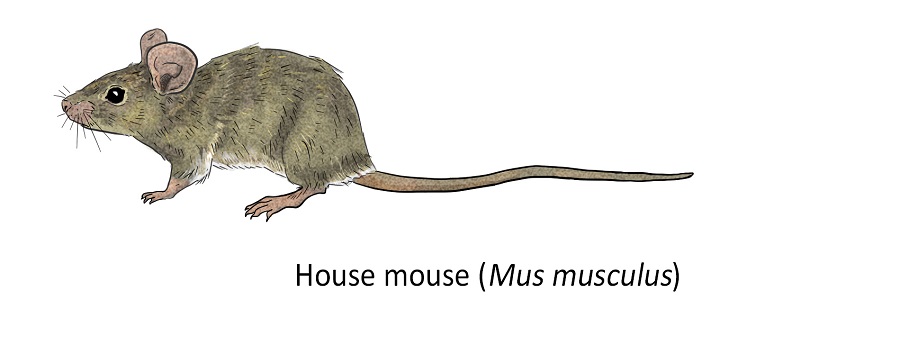
The house mouse is small and has a pointed nose and noticeably large ears. It measures 6.5-9.5 cm long from the tip of its nose to the end of the body, and the tail is 6.0-10.0 cm long. It has light brown to black fur and a lighter underside. It weighs about 20 grams.
House mice have a polygamous mating system. They reach sexual maturity in only six weeks. The females’ gestation period is about 19 weeks. They can produce 6-10 litters in their life span, with 5-6 pups in each litter. They live up to a year.
Behaviour
House mice live in cracks in walls, or burrow underground and make a complex network of tunnels. Indoors, they typically nest in rafters, idle storage areas, and in hidden areas near food sources. They are nocturnal but can sometimes be seen roaming around during the day. House mice are very agile, they are good climbers, and jumpers, and they can also swim, however, they only travel 3-10 m away from their nest. Being so small, they can fit in cracks or holes the diameter of a normal ballpoint pen or about 6-7mm.
House mice are omnivorous and feed on anything such as plant matter, seeds, roots, leaves, stems, indices, meat, and household materials such as soap and glue. They also have low water requirements and can live with just the liquid available in their food. They feed during dusk and during the night, but they can sometimes be seen feeding during the day in an undisturbed area. They have insatiable appetites and eat small amounts of food in frequent intervals, around 15-20 times per day. When favourable conditions are present in an environment, mice can rapidly multiply and cause significant damage and losses on properties.
Leave a Reply