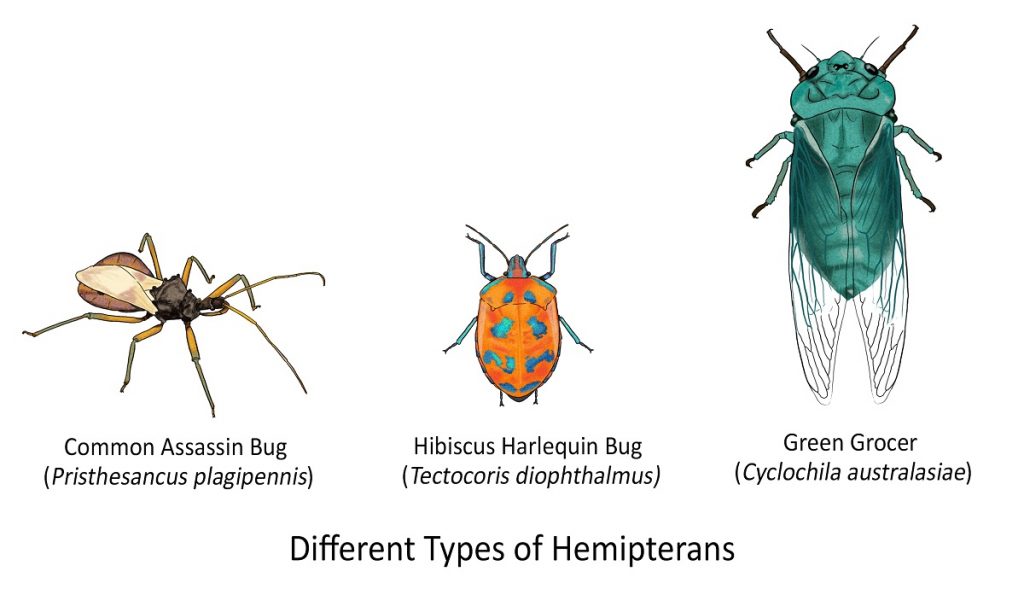
True Bugs
This is a very large group of insects, with over 80,000 described species worldwide. In Australia, there are 5,650 species present.
The evolution of these insects’ mouthparts from chewing to a beak-like arrangement of stylets, capable of piecing tissue, and injecting saliva, allowed the opportunity for exploiting diverse food sources. The success of this insect group is evident in its vast numbers and diversity.
Appearance
This order displays a wide variety of forms, with adults ranging from small to large. Their defining feature is the beak-like mouthparts for piercing and sucking, emerging from the head’s underside. These mouthparts consist of two pairs of bristle-like stylets in a sheath, allowing for the injection of saliva and nutrient extraction. Compound eyes are usually large, and antennae vary in shape and length. Most have two pairs of wings, with forewings often thicker than hindwing. Legs are adapted for walking, except in certain predatory species, and cerci are absent. The nymphs are mostly similar to the adults.
Biology and Behaviour
Most hemipterans primarily feed on plants by extracting sap from various plant parts, while some are predators or external parasites of birds or mammals. Although mostly terrestrial, some species thrive in aquatic environments. Reproduction is mainly sexual, involving copulation and egg-laying on or in host plants, but parthenogenesis or asexual reproduction and live birth also occur in this diverse insect order.
Pest Status
Many hemipterans are crop pests, causing direct damage like wilting or transmitting viral diseases. Bedbugs, of interest to urban pest control, hide in bedding and furniture during the day, feeding on people’s blood at night.