Scientific name: Caryedon serratus
Distribution
Worldwide, subtropical and tropical regions.
Pest Type
Primary pest
Identification
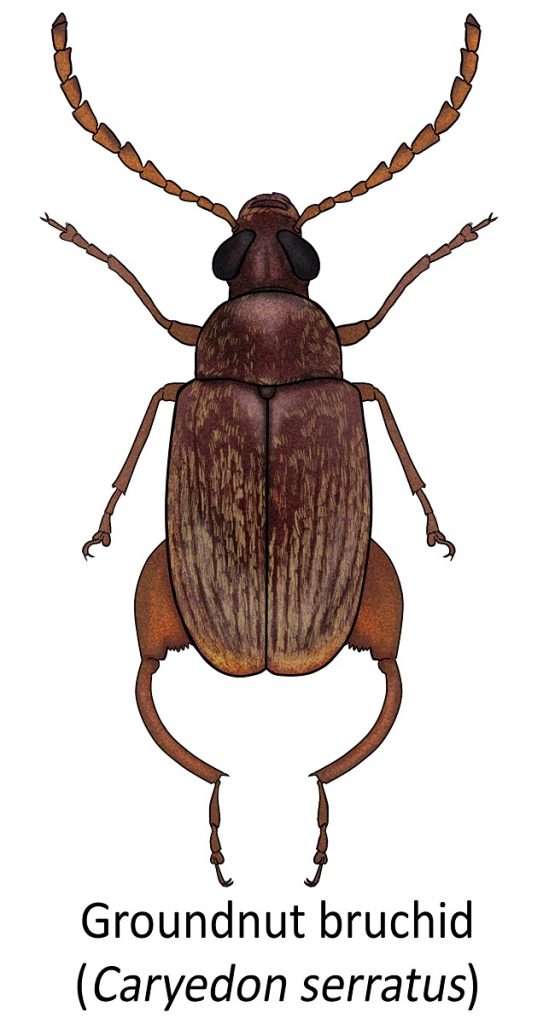
Adult: 7.0 mm, almond-shaped, long legs and antennae. The elytra are light brown in colour and do not fully cover the abdomen. The femur and hindlegs are enlarged, with one tooth and 11-12 smaller ‘teeth’ on the lower edge.
Larva: Scarabeiform, legs are partly developed.
Life Cycle
At optimum conditions of 30–33 ℃ temperature and 70-90% relative humidity, the life cycle will be completed in 42 days. The eggs are glued individually to the pod or seed. Once larvae hatch, they bore into seed and complete the development inside, but may pupate outside the seed in a flimsy cocoon. The adults leave a neat exit hole when they emerge, fly, do not feed on commodities, and are short-lived.
Commodities attacked
Peanuts, groundnuts, and dried tamarind.
Economic importance
High, especially in bagged and stored products in the tropics.