Awesome
German Cockroach
Scientific name: Blattella germanica (L.)
The German cockroach (Blattella germanica) is probably the most widespread and successful cockroach that coexists with humans due to its small size and short life cycle, taking as little as 40 days to develop from hatching to adulthood. This cockroach seeks out moist and humid environments with ample food sources. They are commonly found in food manufacturing facilities, warehouses, storerooms, restaurants, cafes, hospitals, domestic kitchens, under sinks, behind refrigerators, and most types of indoor environments and buildings. The German cockroach is nocturnal. Adults and nymphs find cracks and crevices to hide in during the day and become more active at night. However, if numbers are seen crawling that daytime, especially in non-food handling areas in a building such as bedrooms, it can be assumed that the building is highly infested and immediate control measures should be taken.
Descriptions
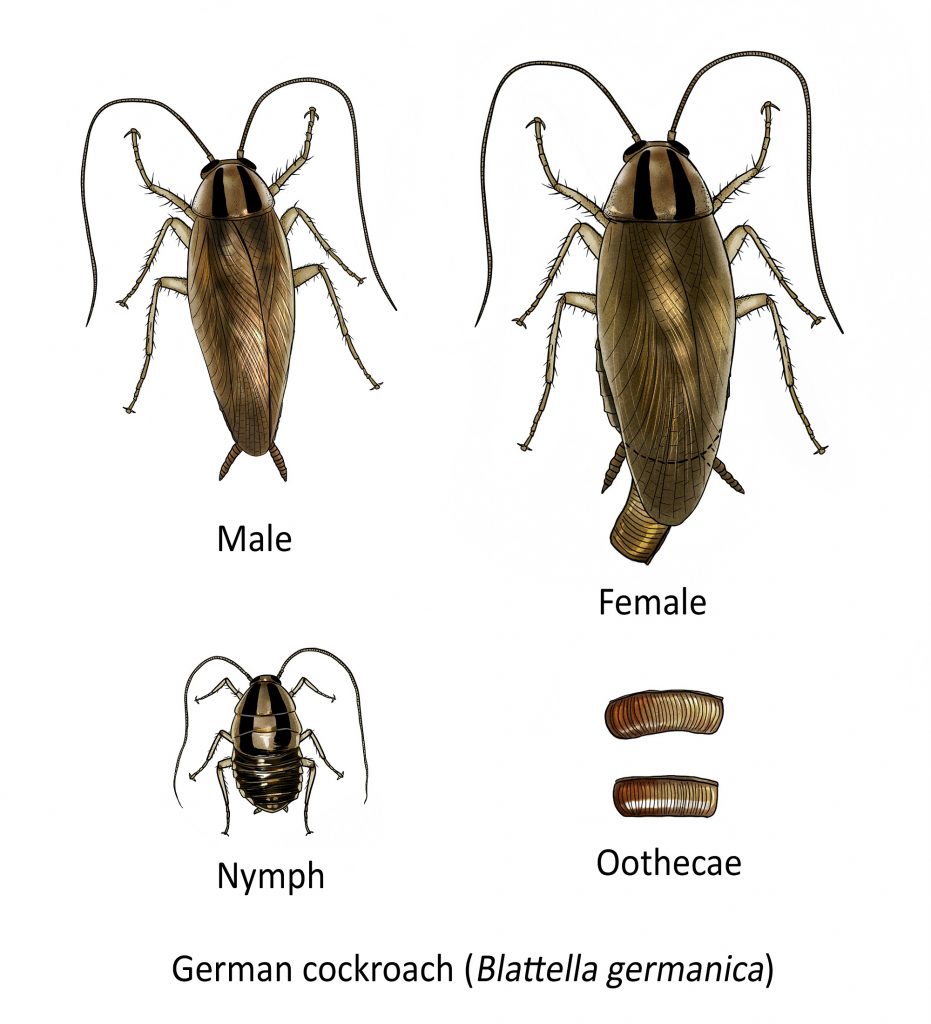
Egg. Egg cases or ootheca are carried by the female until just before they hatch. They can be seen protruding from the posterior end of the female cockroach. Egg capsules are brown in colour and may contain 30–40 eggs per capsule. Generally, there may be 3–4 generations a year.
Nymph.The nymphal stage starts as soon as they hatch from the egg and ends when they reach adulthood. Nymphs typically undergo 5–6 moults or “instars” until they become adults. The nymphs do not have wings, and brown to black in colour. They are characterized by black parallel stripes on their pronotum.
Adult. Adult German cockroaches are 13–16mm long, brown to tan in colour, and are characterized by parallel stripes on their pronotum. The males are thinner than females, with their abdomens narrowing towards the end. Meanwhile, adult females are slightly wider and thicker than males with their abdomens rounded at the end.
Behaviour and Life Cycle
The German cockroach is an omnivore and eats almost any organic material found in food-handling areas ranging from crumbs to built-up grease. If there are enough available water sources, adults may survive a month or more without food. They hide in cracks and crevices during the day, and look for food during the night. They can mostly be seen inside kitchens and bathrooms, under sinks, behind refrigerators, and around the stove, where food and water sources are available.
German cockroaches live for around 200 days. Under favourable conditions, the entire life cycle from egg to adult is completed within 100 days. Although factors such as temperature and food availability may affect this.
Treatment Procedures
Client Preparation and Gaining Access
It is essential for a pest controller to explain the necessary procedures for a German cockroach inspection and treatment to the client. The pest controller should:
- Introduce themselves to the client and explain the work order.
- Tell the client that it is necessary to inspect warm and humid areas near food and water sources such as kitchens, bathrooms, pantries, cracks and crevices, cupboards, behind refrigerators and stoves, dishwashers, washing machines etc.
- Inform the client about the treatment details, the products to be used, and where they will be used.
- Ask for any health issues e.g. asthma
- Explain treatment preparations e.g. all windows need to be closed, the pet’s water bowl should be turned over, clothes on the line should be removed, etc.
- Explain the warranty
- Confirm the approval of the client to proceed.
Pest Controller Equipment for Inspection
Items that can aid in bed bug inspections are listed below:
- A powerful flashlight
- A x10 magnifying lens or hand microscope
- Notepad to record findings
- Digital camera or phone to take pictures of infestation sites
Risk Assessment
Perform a site risk assessment and identify potential hazards or risks within the property.
- Exclude occupants, children, and pets for the duration of the treatments
- Secure pets and make sure they can not escape
- Remove or turn over any pet food or water containers
- Remove clothes on lines
- Cover fish ponds
- Keep a spill kit on site
- Wear the necessary PPE
Inspection
German cockroaches are an indoor species that live in close association with humans. They do not enter premises outdoors and are almost always carried in by humans from another place with an infestation.
- Be aware that German cockroaches can be carried by people into an area.
- Inspecting backpacks, purses, clothing items, groceries and incoming items can prevent infestations.
- Inspection should focus on areas that are vulnerable to pests such as kitchens, bathrooms, pantries, cracks and crevices, gaps in walls, and furniture
- Segment the room with 1-metre bands to inspect areas and items.
- Appliances that provide warmth and food residues like stoves, behind microwaves, refrigerators, dishwashers, coffee makers, toaster ovens, etc. should be checked.
- Also, inspect unsealed openings such as loose pipes, drains, and electrical outlets.
- Identify physical signs of an infestation including live or dead German cockroaches, droppings (black pepper-like specs), egg capsules, and an unpleasant musty odour. If live cockroaches are seen during the daytime, then it may be a sign of an extremely large population.
- Take notes and photographs of findings during the inspection. Documentation will help in developing an effective control strategy.
Non-chemical Control
This control method is focused on preventing infestations, reducing attractants, disrupting their habitat, and generally just making areas less favourable for harbourages.
Sanitation
- Good housekeeping practices are keys to preventing and controlling German cockroach infestations.
- Regularly clean and sanitize areas where food is prepared, consumed, and stored.
- Clean spills immediately, dispose garbage properly and regularly and securely store food in tightly closed containers.
- Declutter storage areas, dispose unnecessary items and organize belongings to minimize potential harbourage sites.
- Fix leaky faucets and pipes if there are any to prevent moisture buildup, as cockroaches can survive for about a month without food, but can only survive for a week without water.
- Vacuuming regularly can physically remove German cockroaches, eggs, and droppings.
- Use a flushing agent, e.g. compressed air into cracks and crevices with harbourages and vacuum up emerging cockroaches. Be sure to empty the vacuum bag or canister into a tightly sealed plastic bag and dispose of it properly.
Structural Proofing
Exclusion involves sealing off entry points and eliminating potential hiding spots for cockroaches.
- Identify areas where cockroaches can enter. Common entry points include gaps around doors and windows, cracks in walls or floors, and openings around pipes, utility lines and vents.
- Seal cracks and gaps with caulk or other suitable sealants. Apply the sealant tightly and make sure that cockroaches could not squeeze through any openings.
- Installing window screens with fine mesh can prevent cockroaches from entering through the open windows.
- Installing door sweeps can prevent cockroaches from entering through the gaps under doors.
Chemical Control
Internal Perimeter Spray
Residual insecticide sprays are used in situations where there the area is heavily infested with German cockroaches because they can quickly reduce heavy indoor populations.
- Read the product label carefully and follow all the directions for mixing the spray and make sure to follow the correct application rate.
- Wear the required PPE based on the label and/or SDS
- Locate cracks, crevices, and where the roaches travel along.
- Only use a 4001 spray tip unless You are injecting into a void.
- Spray Seclira WSG on floors and walls, Biflex AquaMax, or chemicals approved as an internal perimeter spray in the Pesticide List
- Apply a fine spray to all accessible parts of the entire perimeter to all the rooms of the dwelling.
Dust Treatment
Insecticidal dust is an effective way to treat wall cavities, roof voids, and other inaccessible areas. One advantage of using dust is that it provides long-lasting residual control when applied in dry conditions.
- Apply Starrdust PRO (Permethrin + Trimufluron) dust with a power blower into cracks, crevices, and voids.
- Read the product label and follow directions of use, application rate, and the required PPE.
- Apply the insecticidal dust with a handheld puffer in electrical sockets and refrigerator motors.
- Avoid using too much dust.
- Do not apply dust to exposed areas.
- Be cautious when treating near electrical outlets and switches.
Baiting
Baits exploit the natural behaviours of cockroaches such as Coprophagy (eating faces), emetophagy (eating vomit), and cannibalism (eating each other).
- If the bait is consumed, the above behaviours contribute to secondary or even tertiary poisoning when other cockroaches eat the faeces, vomit, or dead bodies of contaminated cockroaches. This makes the efficacy of baits higher compared to surface or baseboard sprays.
- First instar nymphs do not leave their harbourages and feed on the faeces of other cockroaches. This is one reason why the efficacy of baits is higher compared to surface or baseboard sprays.
Using Gel Bait
- Always follow the product labels and directions for use.
- Do not apply bait as if it were caulk; follow directions and the number of placements.
- Use information gathered from inspection and monitoring units; if there were no cockroaches found in a room during inspection or in the monitors, then applying any product would not be necessary.
- Apply Seclira cockroach gel in cracks and crevices, baseboards, under sinks, cupboards, cabinets etc.
Application rate:
When Seclira Cockroach Gel bait, numerous small application spots are better than fewer large spots. The gel spots should be made every 10-20 centimetres in the areas where cockroach activity was identified.
Only a small amount of the bait is needed for each bait point. Each spot should only be 3–6 mm in diameter, which is equal to 0.25-0.50 g of bait.
Where there is a light infestation
- German cockroaches are only observed at night, apply 4-6 bait points per 10 m².
Where there is a moderation infestation
- Apply 7-11 bait points per 10 m².
Where there is a heavy infestation
- German cockroaches are seen during the day and are readily seen when cabinets, cupboards, or pantries are opened, apply 12–24 bait points per 10 m².
Re-application of the gel bait is done when it is consumed or is no longer palatable to German cockroaches. It should not be applied more than once a month unless it is consumed.
Product Rotation
Rotating the use of different insecticides slows down the development of insecticide resistance. Insecticide resistance occurs when cockroaches consume bait but do not die. This leads to customer complaints, callbacks, and terminated contracts. Insecticide resistance in cockroaches has been observed since the start of cockroach control.
Bait aversion
This is a more recent phenomenon that can also lead to control failures. Cockroach baits often contain sugars such as glucose, which makes them palatable to cockroaches. However, in some German cockroach populations, glucose can trigger ‘bitter’ neuronal receptors to fire, causing the cockroaches to avoid glucose and baits containing glucose. Bait aversion is a trait that is inherited, just like insecticide resistance, and is widespread enough that it should be considered when developing cockroach control programs.
Restore the Site
Once you are done treating the area, you must restore it to its original condition. Anything that was moved due to risk assessment, or to gain access to a harbourage should be placed back to where it was e.g. pet’s water bowls should be replaced, replace toaster or microwave if it was moved, any electrical appliances that were removed to use the dusting machine should immediately be reconnected, etc.
Completing documents, Re-entry time, and Post Treatment Expectation
After the treatment, talk to the client and discuss the terms and conditions and the invoice incompletion. You must ensure to discuss when the occupants can re-enter the treated rooms and ventilate the house to allow fresh air to circulate and remove any lingering odour or fumes from the chemicals.
You must discuss what to expect after the treatment. For example, you must explain that the occupants might notice that there is an increase in pest activity after the treatment, which is normal because the pests were flushed out from hiding spots; the cockroach activity should decrease within the first 2 weeks, then over the following weeks. You should also explain the mode of action of the products you used to assure the customer that the treatment will work.
Clean & tidy up
Clean all equipment used during the treatment immediately after use, as dried pesticides are harder to clean. Clean the equipment away from water supplies and children and animals, also check the pesticide label to know how to properly dispose of and store them. Wash and clean your PPE immediately after use. Return all items such as sprayers, warning signs, etc. to the vehicle, and correctly store PPE. Be sure to wash any parts of the body that may have been exposed to the pesticides with soap and water.
Treatment Polls
-
-
test
-
test reply
-
Leave a Reply