Fleas are small parasitic insects that belong to the insect order Siphonaptera — from the greek words siphon meaning tube, and ptera meaning wingless. These refer to two distinguishing characteristics of fleas: the absence of wings and the presence of tube-like mouthparts that are used to pierce through the skin of hosts and drink their blood. There are more than 2,500 species of fleas worldwide, but only 90 of which are found in Australia; 78 of which are endemic.
Fleas are of great importance to the medical and public health field worldwide due to their reputation for transmitting diseases and biting habits that can cause severe irritation to some. Moderate to severe flea infestations are very hard to control and may take months due to the complex interactions between flea populations and humans and their pets. Learning the biology of fleas is an important prerequisite in order to come up with effective control measures.
Morphology
Fleas are very small insects. Adults are 1.5 – 3.3 mm long, and are reddish-brown in colour. Their bodies are “bilaterally flat” or are flattened sideways which allows them to move through their hosts’ fur or feathers, and their strong claws keep them in place. They are wingless insects but have very strong hind legs that enable them to leap 100 times their body length. Their mouthparts are adapted to pierce and suck blood from hosts.
Life Cycle
Fleas undergo a complete life cycle; they have a number of developing stages starting with the egg, followed by a larva, pupa, and finally the adult. In most species, males and females are not reproductively ready when they first emerge the pupa and immediately need to feed on blood to mature and proceed with mating.
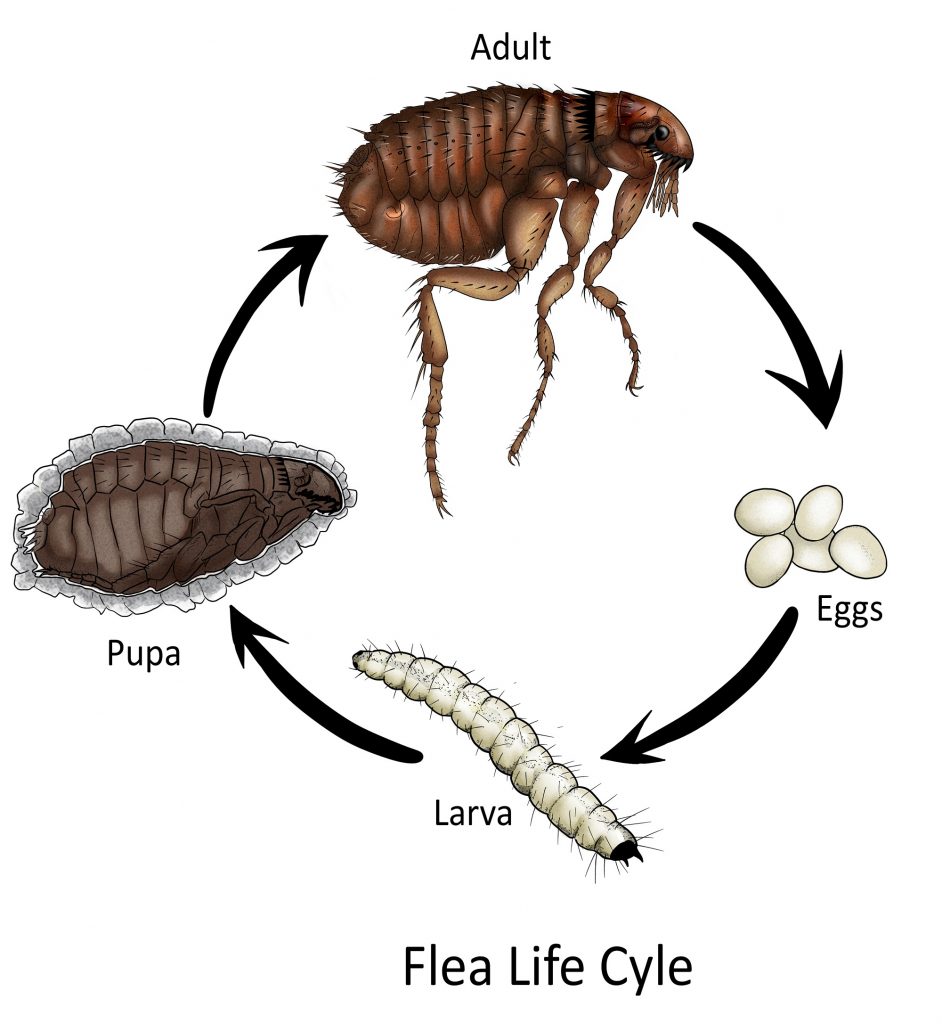
Egg. An adult female can produce 20 – 50 eggs per day. Eggs are oval, white, and about 0.5 mm in size. They fall off the hosts allowing them to be spread throughout the environment. When environmental factors are favourable, the eggs hatch in 2 – 5 days. Flea eggs represent 50% of the total flea population.
Larva. Flea larvae are white, slender, have bristly hairs, and are 3.0 – 5.0 mm in length. They make up 35% of the flea population. They are blind and do not like direct light, so they bury in dark places like cracks and crevices, bedding, carpets, and other furnishings. They feed on flea feces, dead insects, and other available organic material. The larval stage takes about 18 days to complete. After which, they start spinning a cocoon where they would pupate.
Pupa. The pupal stage can take anywhere from 4 days to several months depending on the environment. Vibrations and changes in carbon dioxide levels indicating the presence of a nearby host can trigger the emergence of an adult flea. Flea pupae make up 10% of the flea population.
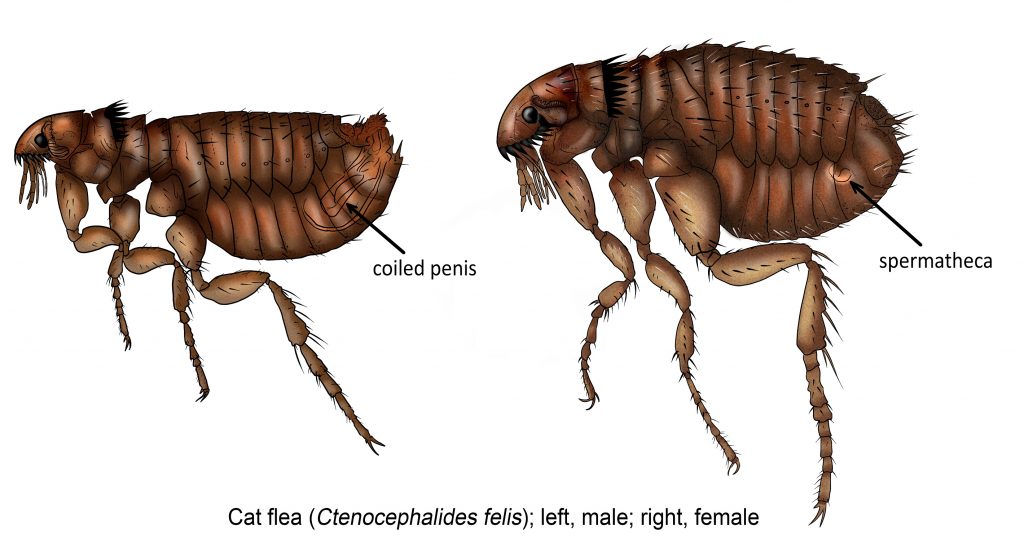
Adult. After the adult flea pops out of the pupa, it immediately needs a blood meal in order to survive and reproduce. Adult fleas live for 2 or 3 months, but without a host to feed on, they will die within a few days. Male fleas are half the size of females and have smaller abdomens. Additionally, when viewed under the microscope, a male flea would have a coiled penis concealed within its abdomen, while a female flea would have a spermatheca — an insect reproductive organ where sperm is stored after mating. Females can lay 5000 or more eggs over their life span. Adult fleas only represent 5% of the total flea population.
Fleas as Pests and Disease Transmitters
Fleas are labelled as pests because of the discomfort resulting from their bites that can cause mild to severe irritation, in most cases, the irritation and bite marks go away over time without any long-term health risks. However, because fleas are known to be parasite vectors and disease transmitters people and pets, it is important to know the diseases that they can transmit.
Plague. The most well-known flea-transmitted disease is the Bubonic Plague, also known as the “black death”. It became an epidemic and killed 25 million people in the 14th century, halving the European population.
The disease-causing bacterium Yersinia pestis is carried by rats and transmitted to fleas that bite them. Infected fleas then bite uninfected hosts, which is how it is transmitted to humans and pets. The plague still occurs worldwide, but Australia has fortunately avoided it for years.
Murine typhus. This is another disease that occurs in rat-infested environments where fleas feed on rats carrying the bacterium Rickettsia typhi. It occasionally is transmitted to humans when infected flea feces are scratched into the bite site or other skin openings, as fleas defecate while they feed on hosts.
Intestinal worm parasite. Fleas are known to transmit parasites such as tapeworms. This primarily affects pets when they accidentally have a tapeworm-infected flea when grooming. However, occasional infections in children may occur.
Allergies. In more sensitive people, flea saliva can cause skin allergies such as dermatitis in the form of red patches or itchy rashes. Some people also have an asthmatic reaction when they accidentally inhale flea feces. Furthermore, pets can also have a negative skin reaction to flea bites that cause frequent scratching, often leading to fur loss.
Important Flea Species
Cat Flea
Ctenocephalides felis
The cat flea is the most common domestic flea. Despite its name, it also feeds on dogs, rats, humans, and other mammals.
Dog Flea
Ctenocephalides canis
Dog fleas are important ectoparasites of both wild and domestic canids around the world. It is similar in appearance to the cat flea but is encountered less. It also feeds on a number of mammals including cats, rats, rabbits, foxes, and humans.
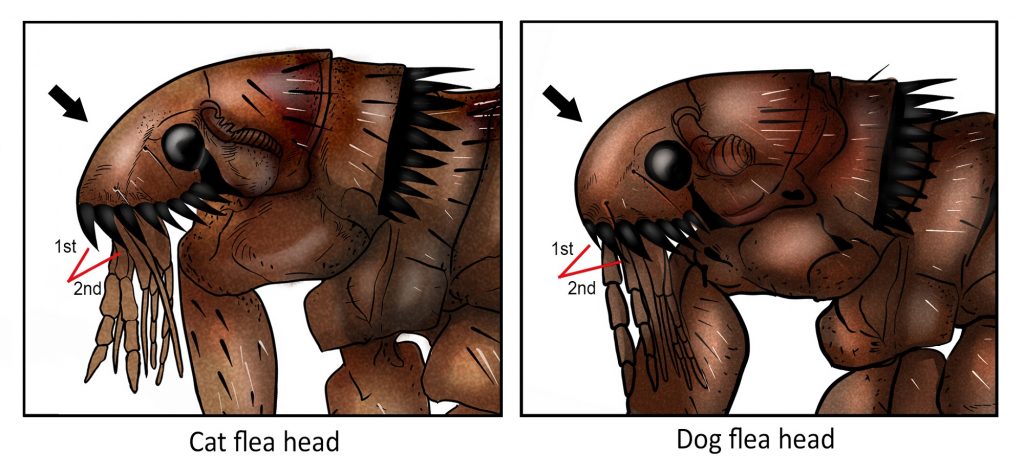
Cat and fleas are very similar in appearance but they have a few defining characteristics that separate them from one another. The most obvious characteristic is the shape of their heads. The dog flea has a more rounded head and its length is less than twice its height, while the head of C. felis or cat flea is more elongated and the length is twice its height. Moreover, the size of the first two spines of the genal comb (“teeth-like” structures above their mouth) is also different between the two species. The first spine genal comb of C. felis is approximately just as long as the second spine, while in C. canis, the first genal comb is noticeably shorter than the second.
Human Flea
Pulex irritans
The human flea is named after its interactions with humans and other animals with close association with humans. It has been implicated as a vector for human pathogens causing plague, murine typhus, and can be a potential vector for tapeworm known to parasitize humans. It is also known to infest attack dogs, rats, mice, and is commonly found in piggeries. However, this pest has become less of a threat to humans since better housekeeping tools have been invented.
Oriental Rat Flea
Xenopsylla cheopis
The primary host for this species are rats, as it is known to be one of the carriers of the bubonic plague bacterium Yersinia pestis. Additionally, it can also be a vector of the murine typhus and at least two types of tapeworm.
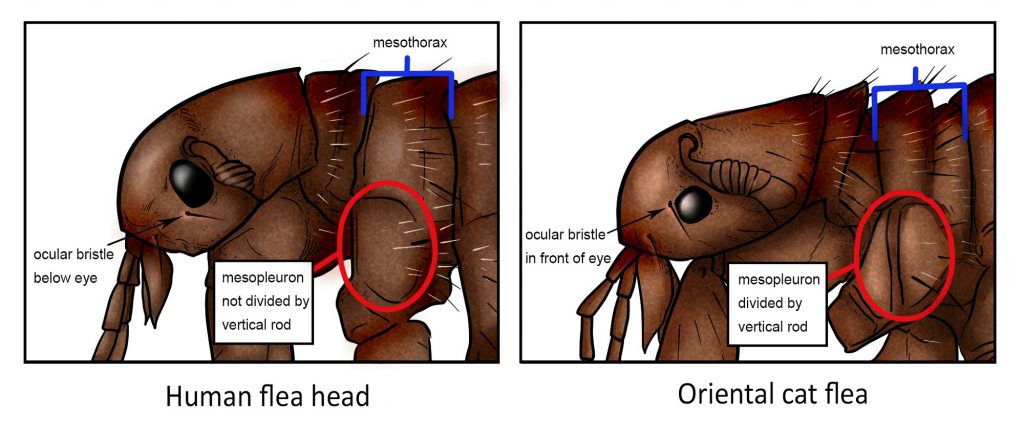
The human flea and the oriental rat flea look a lot alike at first glance and have very subtle morphological differences. Unlike the cat and dog flea, they do not have any genal and pronotal combs. The human flea has an ocular bristle below its eye, while the oriental rat flea has an ocular bristle in front of its eye. In addition, the mesopleuron of the mesothorax (second thoracic segment) of Xenopsylla cheopsis is divided by a vertical rod-like internal sclerotization, while the mesopleuron of Pulex irritans is not.
Planning and Preparing for Inspection and Treatments
Inspection Procedures
The pest controller will conduct an initial assessment where they will ask the occupant/s for information about the flea problem. They will ask about any signs of flea activity such as excessive itching of pets, bites on pets or the occupant/s, live sighting of fleas and flea faeces, and specific areas where fleas have been suspected or seen.
- A visual inspection will be conducted on areas where fleas are commonly found such as carpets, rugs, pet bedding, furniture, upholsters, and premises where the pets frequently spend their time.
- The pest controller will look for live fleas, flea eggs, and flea dirt or flea faeces.
After completing the inspection, the pest controller will discuss their findings with the occupant/s. They will provide recommendations for treatment options and explain any necessary preparations needed before the treatment.
Non-chemical control
Sanitation
Maintaining cleanliness is a crucial requirement for effectively controlling fleas. All areas should be thoroughly cleaned, washed, or swept. Regular vacuuming, especially in areas where pets spend time can help remove eggs, larvae, and adult fleas from carpets, rugs, furniture, and bedding.
Launder bedding, blankets, linen and any other fabric items that the pet has come in contact with in hot soapy water at 35 ℃ or hotter for 10 minutes. Dry the washed fabric at the highest heat setting after laundering to kill the fleas in all life stages.
Additionally, keeping the yard and outdoor areas well-maintained can help reduce flea populations. Mowing the lawn regularly, removing leaf litter, and trimming bushes and shrubs can create an unfavourable environment for fleas.
Natural repellent
Using diatomaceous earth, which is a fine powder made from fossilized algae, can help control fleas. It works by dehydrating and damaging the exoskeleton of fleas, eventually killing them.
Chemical Control
Client Preparation
Pest Controllers should advise the following prior to a flea treatment:
- If your pet has fleas, seek advice from a veterinarian to determine the most appropriate flea treatment for your pet/s (e.g. Frontline).
- Remove clutter from the areas or rooms that will be treated.
- Items such as toys, clothes, pet bedding and sometimes furniture should be removed from the floor to make treatment more accessible.
- Thoroughly clean and vacuum the entire home.
- Pay close attention to areas where the pets frequently spend their time on and include sofa cushions, bedding, and other furniture. Empty the vacuum canister into a plastic bag promptly after vacuuming and seal it tightly to prevent re-infestation.
- Wash pet bedding, blankets, and any washable items that come into contact with fleas with hot water and detergent.
The customer should be advised that the treatment will take at least two weeks to complete due to the life cycle of the fleas.
Store all food, utensils, and dishes securely in cabinets or seal them in plastic bags during the treatment to prevent contamination.
Cover fish tanks to prevent contamination or move them to a room that will not be treated.
Pet birds/bird cages should be removed from the house or the room to be treated.
Occupants and pets must leave the home for 2–4 hours because the room will be sprayed with insecticide that can be harmful before it’s dry.
Treatment
Use a low-toxicity synthetic pyrethroid like permethrin.
Outside areas where pets sleep and frequent should be sprayed.
All carpets and floor surfaces should be sprayed using a superfine spray tip or a misting attachment.
Mats should be turned over and treated on both sides
Pay special attention to areas where pets sleep indoors.
Post-Treatment
Advise occupants to ventilate the treated areas when they return. Open windows and doors to allow air to circulate, which helps dissipate any odours from the treatment.
Do not allow pets back inside until the rooms have been ventilated.
- Advise occupants that fleas will continue to emerge for about 2 weeks after the treatment because the spray does not kill fleas in the pupal stage. The adult fleas that the clients see after the treatment are newly emerged fleas that have yet to contact the insecticide treatment.