Cryptotermes brevis
Common names:
This termites is a restricted matter under the Biosecurity Act 2014. If you find evidence of its activity, you must report it within 24 hours to our Customer Service Centre on 13 25 23 or online.
West Indian drywood termite
Powderpost termite
Distribution
This is an introduced species and is widespread throughout the world. It was first identified in Maryborough, Queensland in 1964.
Identification
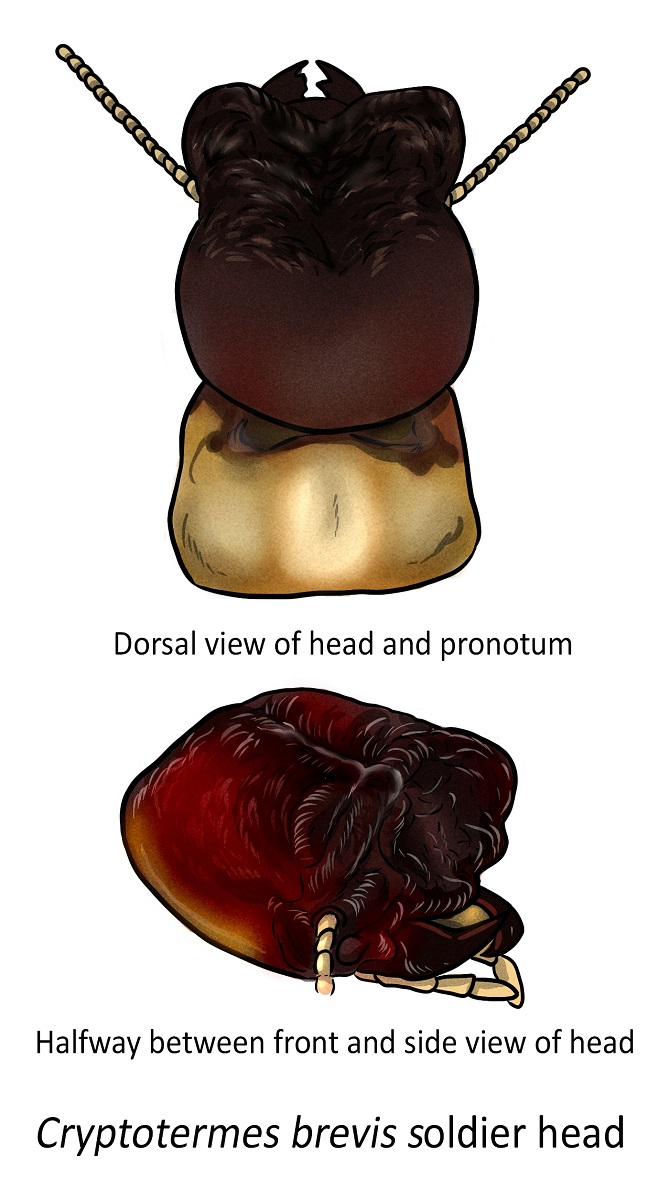
Soldiers are 4.2–5.8 mm in size. They have short and broad mandibles that when viewed from the side, curve upwards. They have dark and roguse or wrinkled heads that are constricted behind the front lobes.
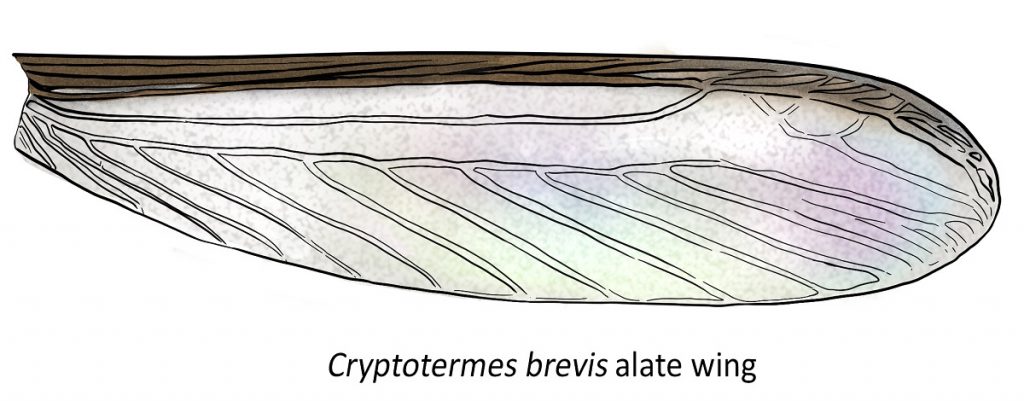
Alates of this species can be easily identified with their hairless iridescent wings and their wing venation. Each wing has three or four darkened and enlarged veins (subcosta and branches of radius) along the coastal margin.
Habitat and Behaviour
This is one of the most destructive species of termite in the world. It attacks both the heartwood and sapwood of timber. Its damage often remains undetected until the structure collapses. It is typical for multiple colonies to infest the same structure. Unlike most species, C. brevis has a tendency to infest smaller pieces of wood. Its presence can be detected by the presence of hexagonal fecal pellets or termite frass that is often found near “kick-out” holes.
Hosts
The West Indian drywood termite is typically found in:
- Hoop pine (Araucaria cunninghamii)
- Pine and pine hybrids (Pinus species)
- Red cedar (Toona ciliata)
- Sily oak (Grevillea robusta)
- Cabinet timbers such as maples (Flindersia species)
Spotted gum (Corymbia citriodora subspecies variegata) shows some resistance to these termites.
General Treatment Procedure
Pest Controller Equipment
Items that can aid in a drywood termite inspection include the following:
- A powerful flashlight
- A moist meter
- A long-handled probe or screwdriver
- A phone to take photos and/or take notes
- A x10 magnifying glass
Client Preparation
Getting the home ready for an inspection is not a complicated task, but there are a couple of steps the client can take to ensure the inspection goes smoothly.
- Make sure the technician can access areas, primarily the attic, sink, garage, and crawl space if there is one.
- Make sure to move any items that block expansion joints and anything that blocks access under the sink or into crawl spaces.
- Move items that are stored against the wall about half a metre away from the wall.
Inspection
It’s difficult to detect drywood termites because of their cryptic nature. They live entirely within the wood and they don’t leave many signs of their presence. However, there are techniques and signs to look out for in order to detect a drywood termite infestation during an inspection.
To complete an inspection, the entire perimeter and inside of the property should be thoroughly examined.
- Pay close attention to window sills and frames, door frames, wooden doors, wooden cabinets, wooden furniture, wooden floors, wooden walls and ceilings, and wood piles near the foundation of the home.
- Look for feeding damage, shed wings, fecal pellets, and kick-out holes (small holes through which termites push fecal pellets out of wood).
- The fecal pellets have six sides and are found in a pile— this is an indication that there are drywood termites present.
- When there is a pile of fecal pellets, there is a kick-out hole near or above it.
- Piles of wings are an indication of an infestation.
- Damaged wood that looks like it was crushed or hollowed out is also a sign.
- Lightly tap the wood with a screwdriver handle of a similar tool and listen if there is a hollow, papery, rustling sound. By doing this, frass or fecal pellets may fall off the areas you tap on.
If you discover signs of West Indian drywood termite activity, gather a sample and report it to Biosecurity Queensland at 13 25 23 within 24 hours. You may send physical samples of multiple soldier bodies, heads, frass, or wings. Alternatively, you can submit high-resolution digital photographs of the termites, frass, and any damage they have caused.
Non-chemical Control
Exclusion methods of drywood termites include:
- Controlling moisture during construction of the building in areas prone to drywood termites.
- Using a 20-mesh screen to cover all soffit vents, doors, and windows in buildings constructed with wood frames.
- Applying a good coat of paint to exposed wood can give a certain level of defence against termite infestation. Prior to coating, it is necessary to fill any gaps or holes with putty or plastic wood.
- Using microwave energy to kill termites in small areas of wood.
- Electrocution via a handheld high-energy, low-current “gun”.
- Using pressure-treated wood resistant to termite infestation. There are certain types of wood that are naturally resistant to termite attacks such as spotted gum, ironbark and cypress pine, and mahogany. However, these woods can be more expensive and may lose their resistance over time due to aging and exposure to weather conditions. Constructing should be designed in a way that minimizes moisture and prevents water leaks.
- Removing the infested wood and replacing it is the best option if the drywood termite infestation is isolated.
Chemical Control
Spot treatment
The key to successful termite foaming is to get as much foam in contact with as many termites as possible.
If the kick-out holes have been identified, drill directly into the kick-out holes and inject Termidor foam for 5–10 seconds, allowing it to expand for up to 30 times its initial size. This allows the foam to spread and travel through the galleries inside the wood and makes it impossible for termites to escape.
If the drywood termites are infesting the studded walls, drill a hole close to the top of each stud and once they are made, inject Termidor foam into each hole for 5–10 seconds. Allow the foam to expand and move along the sides of the studs to reach the termite galleries.
If the drywood termites are infesting near the baseboards, drill holes every 20–25 cm between the studs, about 3–5 cm above the baseboard. Inject each hole with the foam white maintaining a consistent injection rate.
Termidor foam is non-repellent, meaning the termites cannot detect its presence when applied. When termites come in contact with the treatment, they carry the active ingredient on their bodies. They transfer the Fipronil to other members of the colony through their grooming and feeding behaviour, so even if some termites are missed initially, the rest of the colony will soon be affected.
Termidor foam remains active after the initial treatment for 4–6 weeks. It is important to be patient with this type of treatment as it is non-repellent and can take up to 90 days to eliminate the colony.
Fumigation
Fumigation is an extremely technical method of removal of microorganisms and other pests by completely exposing an area to gaseous pesticides or fumigants to suffocate and kill the pests. Fumigation involves “tenting” or surrounding the entire building exterior with a gas-tight tarpaulin or a tent encase to create a sealed environment. Sulfuryl fluoride is released inside the enclosure, followed by aeration to 1 ppm or less.
Structural fumigation is a highly advantageous control method for Cryptotermes brevis and other drywood termites because it eradicates pests throughout the building, including inaccessible infestations.
Thermal Treatments
This type of control method can also be used but only for single rooms and not for whole-house treatments because it uses heat administered with propane or electric heaters.
Leave a Reply