Cockroaches
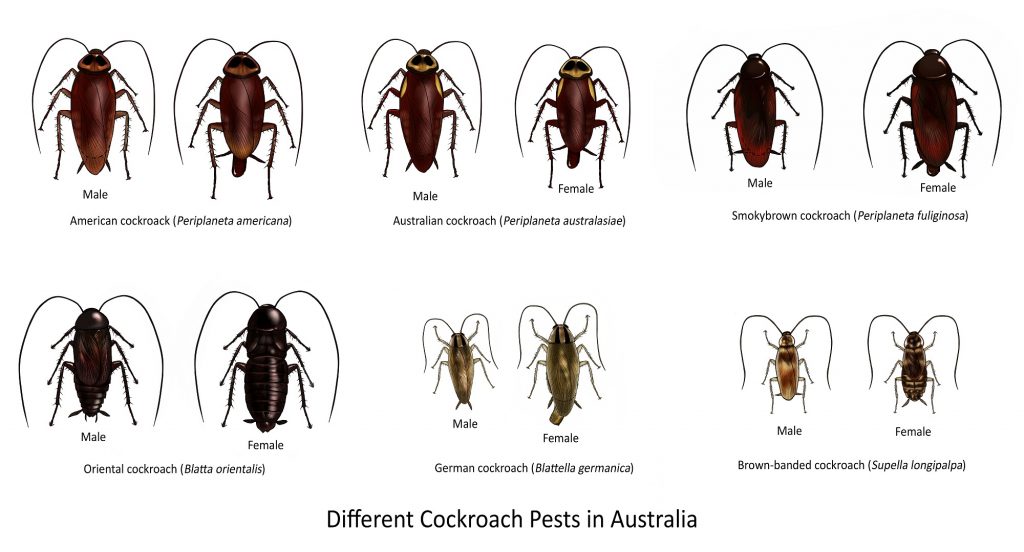
There are 4500 species of cockroaches in the world, 450 of which are in Australia.
Appearance
Adults are medium to large in size depending on the species. When viewed from above, they have a flattened oval-shaped body that allows them to squeeze into cracks and crevices. They have visible pronotums, which is the big shield-like structure that is often mistaken as their head. The head is located right underneath the pronotum, and is equipped with chewing-type mouthparts that allows them to feed on most types of food. Attached to their head is a pair of usually long thread-like antennae. Their legs have protective spikes that aid them in crawling and running on a variety of surfaces, and their wings can either be present, reduced, or absent. They often have prominent cerci attached to their abdomen, which are sense organs present in both male and female cockroaches.
The Nymphs are mostly similar to the adults except for the size, development of wings, reproductive appendages, and sometimes the colour and texture of the cuticle.
Biology and Behaviour
Cockroaches are frequently seen mostly in dark, humid places and are nocturnal. They hide during the daytime in cracks and crevices inside a building, or under darks outside. Some native species eat decaying wood, but they are generally omnivorous. Some species are capable of flying but require warm conditions.
Cockroaches undergo courtship rituals before they reproduce sexually, which often involves a release in attractant pheromones. Their young often grow outside of the mother’s body, and inside a purse-shaped egg case called “ootheca”. An ootheca may contain 12-40 eggs depending on the species. Egg cases may be glued on to surfaces or dropped just prior to, or a few months before hatching. After hatching, nymphs undergo several moults until they become adults and may take 2-4 months in some smaller species, or up to a year or more in others.
Pest Status
Cockroaches are predominantly tropical or subtropical. A number of species have been successful at dispersing worldwide and exploiting building environments with the help of commerce. Many such environments provide favourable conditions such as warmth, food and shelter year-round, which can support literally thousands of roaches.
Cockroaches eat stored food and other materials. They can also contaminate foods with droppings, cast skins, as well as pathogens including Salmonella, and other organisms causing gastroenteritis, dysentery, tuberculosis, hepatitis, typhoid fever, and many more.