American Cockroach
Scientific name: Periplaneta americana (L.)
The American cockroach is probably the largest cockroach that infests dwellings and utilities, reaching 35–40 mm in length. It prefers warm, moist, and dark conditions. It tends to live indoors in colder regions but prefers outdoors in warmer conditions. It is a very widespread pest occurring in drains, sewers, and infrastructures where food and water sources are readily available.
Descriptions
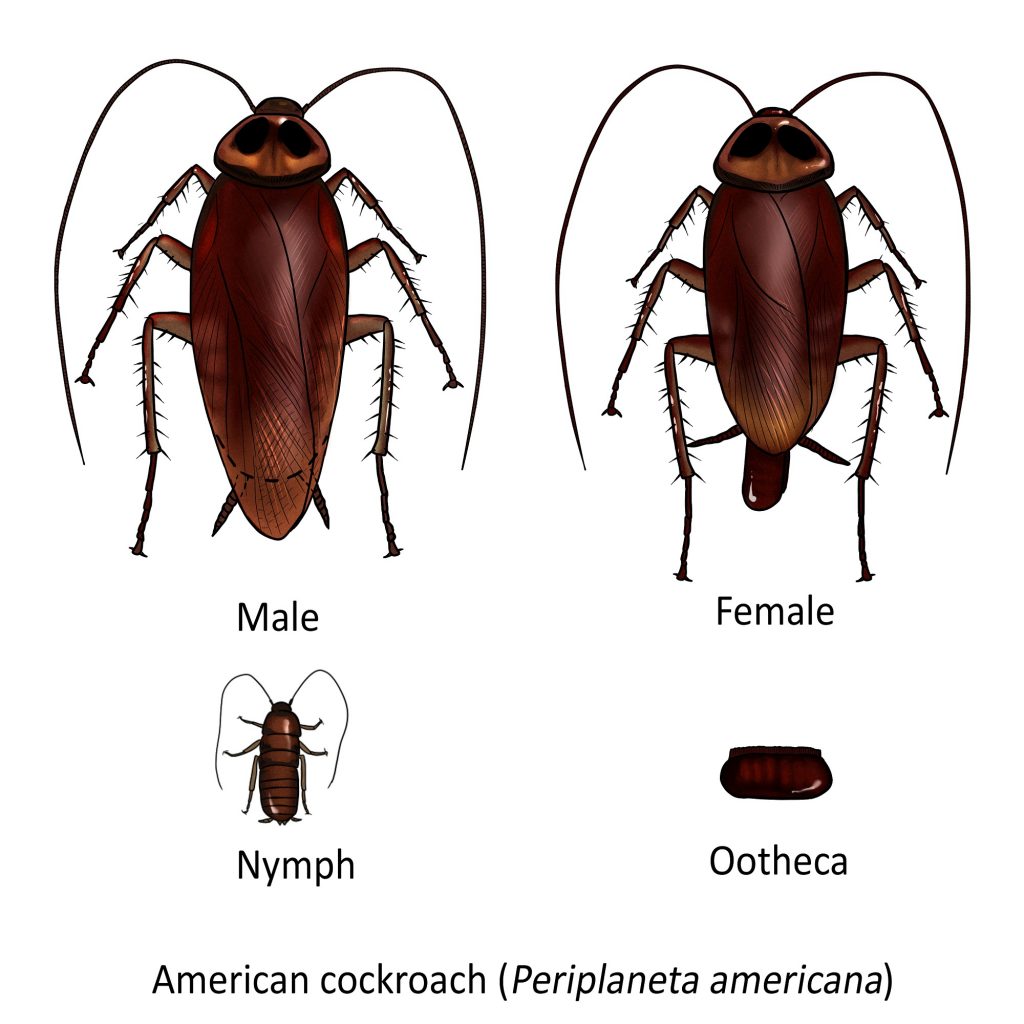
Egg. Egg cases are usually dropped or glued to surfaces near food and water sources. The female may also glue the ootheca in hidden places to protect them from predators, parasites, and technicians. Each egg case can contain 12–16 eggs. The egg case is brown when deposited and turns black in a day or two.
Nymph. American cockroach nymphs after immediately hatching are white in colour then become brown after a few hours. This is also the case every time after they moult. Nymphs may take 6–12 months to develop into adults.
Adult. The adult American cockroach is reddish-brown in colour with a pale yellow border around the pronotum. Males appear longer than females because their wings go beyond their abdomen. Males also have longer cerci than females, and they have a pair of styli in between their cerci while females do not. The lifespan of an adult maybe be 6–12 months and females produce up to 50 egg cases within this time.
Behaviour and Life Cycle
This cockroach can readily be found in buildings such as food manufacturing facilities, hotels, apartment buildings, restaurants, and domestic residences. Although they are rarely found in houses, infestations may occur after heavy rain. The American cockroach is omnivorous and an opportunistic feeder. It has a preference for decaying organic matter, but will eat most human, and animal foods and also book bindings, paper, and clothing.
The life cycle from egg to adult averages about 600 days and the adult life span may be another 400 days. The nymphs emerge from the egg case after 6–8 weeks, and mature into an adult in 6–12 months, given that environmental factors such as temperature, humidity and food availability are favourable.
American Cockroach Treatment
Unlike German cockroaches, American cockroaches primarily live outdoors they will also live indoors they need a quite dark place to shelter during the day. Often they shelter in wall cavities, roof voids and in the voids under sinks kitchen cupboards and bathrooms. If they are sheltering during the day outside these harbourages are often: grease pits; sewers; service pits; outdoor barbeques.
At night they leave their habourage in search of food and mating opportunities. They enter buildings through cracks, crevices, door gaps, sewer connections, air ducts, and other openings. They can also be introduced inside a building via hitching a ride on bags, and other containers.
Treatment Procedures
Client Preparation and Gaining Access
It is essential for a pest controller to explain the necessary procedures for an American cockroach inspection and treatment to the client. The pest controller should:
- Introduce themselves to the client and explain the work order.
- Tell the client that it is necessary to inspect warm and humid areas near food and water sources such as kitchens, bathrooms, pantries, cracks and crevices, cupboards, behind refrigerators and stoves, dishwashers, washing machines etc.
- Inform the client about the treatment details, the products to be used, and where they will be used.
- Ask for any health issues e.g. asthma
- Explain treatment preparations e.g. all windows need to be closed, the pet’s water bowl should be turned over, clothes on the line should be removed, etc.
- Explain the difference between German cockroaches and “large” cockroaches
- Explain the warranty
- Confirm the approval of the client to proceed.
Pest Controller Equipment for Inspection
Items that can aid in bed bug inspections are listed below:
- A powerful flashlight
- Notepad to record findings
- Digital camera or phone to take pictures of infestation sites
Risk Assessment
Perform a site risk assessment and identify potential hazards or risks within the property.
- Exclude occupants, children, and pets for the duration of the treatments
- Secure pets and make sure they can not escape
- Remove or turn over any pet food or water containers
- Remove clothes on lines
- Cover fish ponds
- Keep a spill kit on site
- Wear the necessary PPE
Inspection
- Check kitchens, bathrooms, basements, utility rooms, and crawl spaces as American cockroaches prefer warm, dark, and moist environments.
- Look for droppings (they resemble coffee grounds), oothecae or egg cases, and live nymphs or adults.
- Inspect potential entry points, since American cockroaches can enter premises through small cracks and gaps.
- Check windows, doors, utility openings, vents, and any other areas where they can gain access.
- Use a flashlight to inspect dark and secluded areas like tight spaces, behind appliances, and inside electrical boxes.
- Document findings and take photographs of signs that were found during the inspection.
Non-chemical Control
Since American cockroaches primarily thrive outdoors, exclusion and sanitation are the main methods of defense against them. Reducing access to harbourages inside is also important.
Sanitation
- Get rid of clutter because it created harborage that provides hiding spots.
- Get rid of available food and water sources that can compete with bait applications.
- Immediately clean food and beverage spills.
- Vacuum regularly and properly dispose of the debris in a sealed plastic bag.
Physical/Mechanical Control
- Fix plumbing leaks, gutters, and other sources of water or moisture.
- Place trashcans away from doorways. Additionally, use garbage bins with tight-fitting lids and plastic liners and religiously empty them at the end of the day so food waste would not be left overnight.
- Clean drains.
- Seal up all cracks, crevices, and holes on walls and floors with caulk to get rid of entry points.
- Installing door sweeps to block gaps under doors.
Chemical Control
Outdoor Treatment
- Do a perimeter treatment using Biflex Aquamax. This will serve as an outdoor barrier protection that will help prevent roaches from entering the house.
- Read the label to determine the correct application rate and PPE to be used.
- Spray across door thresholds, in the corners around the doors, window sills and openings around the windows where roaches can crawl into, eaves of the house and its corners, under decks and where the deck meets the house, under the bushes, and the foundation of the house.
- Insecticidal dust is an effective way to treat wall cavities, roof voids, and other inaccessible areas. One advantage of using dust is that it provides long-lasting residual control when applied in dry conditions.
- Dust weep holes with Permethrin dust using a handheld puffer
- You must apply Dust to the exterior wall void
- You must only use a product described as an Approved Dust in the Pesticide List
- Ensure Dust does not come into contact with caged birds or fish.
- For brick veneer dwellings, use a Dusting Machine to distribute Dust at the Label Rate into the wall cavities via the weep holes.
- For weatherboard homes, use a Dusting Machine to distribute Dust at the Label Rate into the wall cavities by placing the nozzle under the lowest board.
- Where the construction of the building or any other condition prevents the safe application of dust into the wall cavities you must not apply dust in an unsafe manner and you must notify us of the reason[s] the application would have been unsafe and any alternative treatment carried out when You Complete the Job.
- Replace the Dusting Machine into a secure part of Your Vehicle.
- Remove the electrical extension cord and either turn off the power point or replace the power cord for the appliance that was previously inserted into the power point.
- Double check to ensure that any electrical appliance, in particular any fridge or freezer has not had its power supply interrupted.
Indoor Treatment
Dusting cracks, crevices, and behind appliances
- Read the product label and follow directions of use, application rate, and the required PPE.
- Apply permethrin dust with a power blower into cracks and crevices.
- Apply permethrin dust with a handheld puffer behind the fridge, dishwasher, and other appliances.
- Be cautious when treating near electrical outlets and switches.
Dusting the roof void
- Only apply Dust listed in the Pesticide List as an Approved Dust.
- If you remove an electrical appliance lead in order to connect the Dusting Machine you must reconnect the appliance immediately after You have finished applying dust to the roof void.
- Use a ladder to remove the access point (manhole) cover.
- Use a torch to inspect the roof void before applying Dust to the roof void.
- Using the Dusting Machine’s dust/air mixture control and the extension wands you must apply an even distribution of dust to the entire roof void.
- If it is not possible to apply an even distribution of Dust from the manhole You must enter the roof void to complete the operation.
- If You enter the roof void you must not allow any component of the roof to bear of any significant portion of your body weight that is not either:
- a part of a truss; or
- substantial roof support (obviously capable of supporting the weight of your body) .
- If there is no access to the roof void or it is unsafe to access the roof void you must notify us when you Complete the Job.
- If the access to the roof void is obstructed you must within 24 hours and you must make reasonable efforts to return to Apply Dust to the roof void.
- Where access is obstructed You must not Complete the Job until either:
- Dust has been applied to the roof void; or
- You have received written authorisation from us to Complete the Job.
Sprays
- Read the product label carefully and follow all the directions for mixing the spray and make sure to follow the correct application rate.
- Wear the required PPE based on the label and/or SDS
- Locate cracks, crevices, and where the roaches travel along.
- Only use a 4001 spray tip unless You are injecting into a void.
- Spray Seclira WSG on floors and walls, Biflex AquaMax, or chemicals approved as an internal perimeter spray in the Pesticide List
- Apply a fine spray to all accessible parts of the entire perimeter to all the rooms of the dwelling.
- Apply Chandrite Extra Strength, or other approved aerosols in the Pesticide List behind the washing machine, dishwasher, etc.
Gel baits
- Apply the Seclira cockroach gel near harbourages or where cockroach activity was observed.
Where there is a light infestation
- Cockroaches are only observed at night, apply 4-6 bait points per 10 m².
Where there is a moderation infestation
- Apply 7-11 bait points per 10 m².
Where there is a heavy infestation
- Cockroaches are seen during the day and are readily seen when cabinets, cupboards, or pantries are opened, apply 12–24 bait points per 10 m².
Re-application of the gel bait is done when it is consumed or is no longer palatable to cockroaches. It should not be applied more than once a month unless it is consumed.
- Possible placements include baseboards, under sinks, cupboards, cabinets, etc.
- Check bait placements to clean or replenish as needed.
- Do not apply where food or feed is prepared.
- Apply in areas where is it not easily accessible to children or pets.
- Do not apply in areas that were recently treated with insecticide.
Restore the Site
Once you are done treating the area, you must restore it to its original condition. Anything that was moved due to risk assessment, or to gain access to a harbourage should be placed back to where it was e.g. pet’s water bowls should be replaced, replace toaster or microwave if it was moved, any electrical appliances that were removed to use the dusting machine should immediately be reconnected, etc.
Completing documents, Re-entry time, and Post Treatment Expectation
After the treatment, talk to the client and discuss the terms and conditions and the invoice incompletion. You must ensure to discuss when the occupants can re-enter the treated rooms and ventilate the house to allow fresh air to circulate and remove any lingering odour or fumes from the chemicals.
You must discuss what to expect after the treatment. For example, you must explain that the occupants might notice that there is an increase in pest activity after the treatment, which is normal because the pests were flushed out from hiding spots; the cockroach activity should decrease within the first 2 weeks, then over the following weeks. You should also explain the mode of action of the products you used to assure the customer that the treatment will work.
Clean & tidy up
Clean all equipment used during the treatment immediately after use, as dried pesticides are harder to clean. Clean the equipment away from water supplies and children and animals, also check the pesticide label to know how to properly dispose of and store them. Wash and clean your PPE immediately after use. Return all items such as sprayers, warning signs, etc. to the vehicle, and correctly store PPE. Be sure to wash any parts of the body that may have been exposed to the pesticides with soap and water.
Leave a Reply