Lice are wingless parasitic insects that belong to the order Phthiraptera. There are about 3,000 species worldwide, of which 200 are represented in Australia. Lice are obligate parasites, meaning they cannot complete their life cycle without externally feeding on warm-blooded hosts which include almost every species of bird and mammal.
The four suborders of Phthiraptera are:
- Anoplura – these are lice that have piercing-sucking mouthparts that are found on mammals, including humans.
- Amblycera – These are lice that have chewing mouthparts and feed on the hair or feathers of mammals are birds.
- Ischnocera – These are lice that have chewing mouthparts and feed on skin of their hosts, which are birds.
- Rhynchopthirina (formerly Mallophaga) – these are lice that have piercing-sucking mouthparts that are found on elephants and warthogs.
Morphology
Lice are usually 1.5–3.5 mm long, wingless, and have flattened bodies. They have short antennae, their eyes are either absent or small when present, and their legs have ‘claws’ that help them move through hair or feathers.
Life Cycle
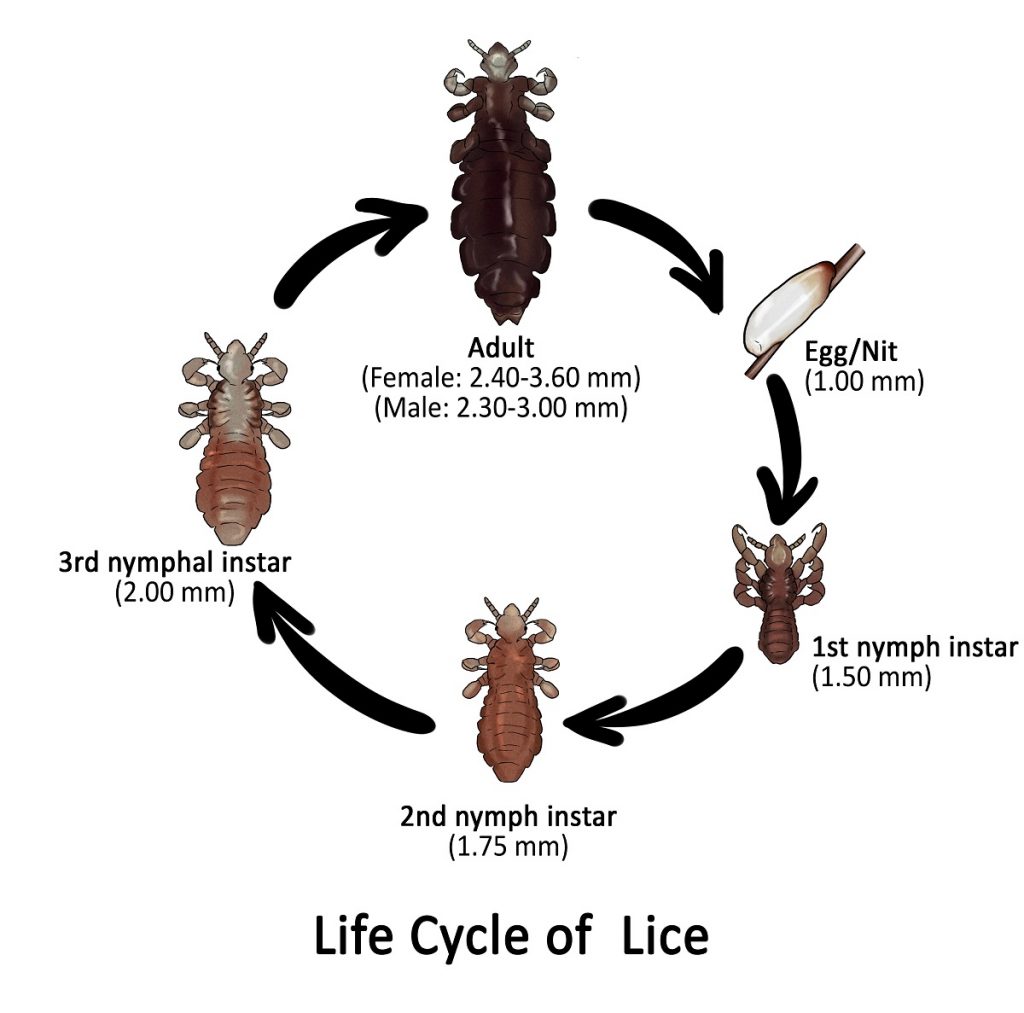
Lice undergo gradual metamorphosis, meaning the nymphs look like adults but are smaller in size. The eggs or ‘nits’ are usually glued to the host’s hair, or to clothing seams that are in close contact with the skin in the case of body lice. The eggs hatch within 5–10 days, and the nymphs feed on blood in order to survive. The nymphs undergo two to three instars before they become adults. The life cycle is typically completed in 3–4 weeks. Adults live for about a month and during this time period, the females will lay up to 200 eggs, or 6–8 nits per day.
Lice only survive for one to two days without a host.
Behaviour
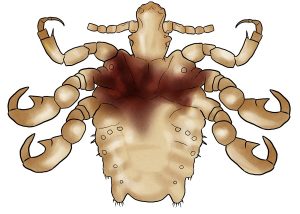
Lice lice on the surface of their host’s body and rely on the host for survival. They need a blood meal to survive, which they obtain by biting the skin and sucking blood day and night. Lice are generally host specific, and some lice only attack certain body regions. For example, human lice (Pediculus humanus capitis) only infest humans and prefer to live in the hair on the head, while crab lice (Pthirus pubis) often infest the pubis area.
Lice cannot jump or fly so they are primarily transmitted by direct head-to-head contact or by sharing personal items such as combs, brushes, hats, clothing, or bedding. They are also very sensitive to temperature and tend to leave dead or dying hosts to look for another.
In Australia, pediculosis (infestation of the human body lice) is mainly associated with head and crab lice. Their feeding behaviour of biting the skin and inserting saliva may cause irritation and scratching which in severe cases, lead to local infection of bite wounds.
Diseases caused by Lice
The body louse has been responsible for much human fatality because of the diseases that they transmit, such as:
Epidemic typhus. This disease was caused by the bacterium Rickettsia prowazetti and was highly fatal and caused millions of deaths in previous centuries, but is now considered a rare disease. The louse feeds on an infected host and the bacterium develops in its body. The bacteria can also be transmitted through louse faeces that are scratched into broken skin or mucous membranes. This disease is associated with crowded and unsanitary conditions, where body lice thrive.
Trench fever. This disease is relatively common and non-fatal. It is caused by Rechalimaea quintana. Like the epidemic typhus, this disease is associated with crowded and unsanitary conditions. The transmission also depends on the louse taking an infected blood meal from the host, and it or its faeces are crushed or scratched into the bite wound.
Relapsing fever. It is an infectious disease caused by Borrelia bacteria transmitted by lice. It leads to recurring episodes of high fever, chills, and other flu-like symptoms. Fatalities from this disease are few except in cases where the human host is undernourished.
Important Lice Species
Human Head Lice
Human Body Lice
Crab Lice
Lice Prevention and Control
Body lice, as well as crab lice prevention and control, relies on improving personal hygiene of the infested individuals.
To prevent and control a human life infestation of any kind, one must:
- Bathe regularly
- Change into fresh clothes as much as possible
- Machine wash infested clothing and beddings with hot water at least 54°C for 5-10 minutes and then heat dry.
- For clothing and items that can’t be washed, have them dry-cleaned or sealed in a plastic bag and stored for 2 weeks.
- Do not share clothing, beds, bedding, combs, towels, and hats used by an infested person.
Chemical control
A pharmacist or other health professionals should give advice on what products to use for treating human lice. Labels and directions of the product should be followed accordingly as some products may advise more than one treatment.
For head lice products, the active compounds are:
- Pyrethrins
- Synthetic pyrethroids (permethrin, bioallethrine)
- Organophosphates (maldison or malathion)
- Herbal, with or without natural (non-chemical) pyrethrins.
If a client called about a confirmed lice infestation, the pest controller much give them advice to consult health professionals instead so they could get the appropriate and approved products with insecticidal formulations for treating lice.