Order
Dermaptera
Distribution
Widely distributed in Australia, highly diverse in the tropics and subtropics.
Identification
Earwigs range from 5–50 mm. The largest extant earwig species, Titanolabis colossea, or the giant earwig can be found in the East coast states of Australia and ranges from 50-60 mm in length.
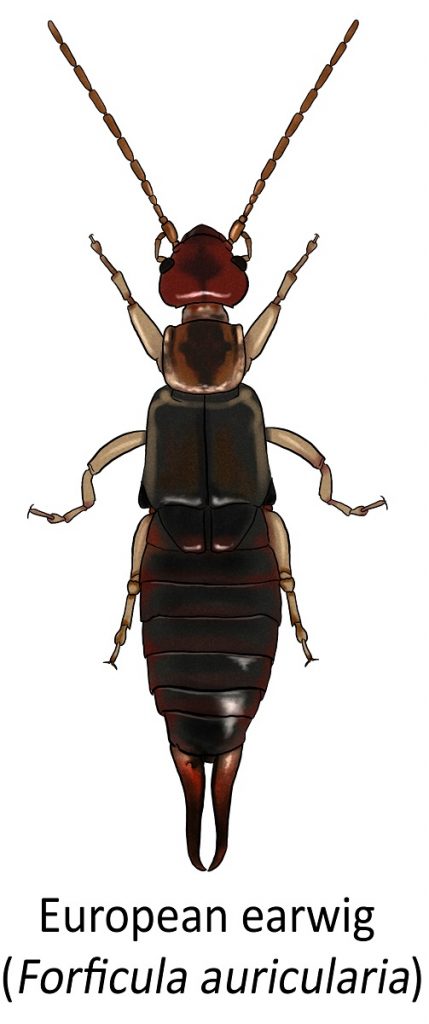
Earwigs have cylindrical and flattened bodies that come in different colours including: yellow, yellow-brown, orange-brown, reddish brown, dark brown, and black. Their abdomen is telescopic They can be winged or wingless. They have forcep- or pincer-like cerci at the end of their abdomen, which makes them look intimidating.
Earwigs use their cerci to grab prey, defence, and mating. The males use them to grab one another and brawl like a wrestling match. The pincers come in different shapes and sizes and can be used for sexing earwigs; males have curved pincers and females have relatively straight pincers.
Behaviour
Earwigs are nocturnal and spend the day hidden in debris, and at night they become active. Earwigs are omnivores and feed on a wide variety of plant and animal matter. However, there are some species that are predominantly plant eaters or predators.
Earwigs as pests
Generally, Australian earwigs are not considered serious pests. However, the introduced species, European earwig (Forticula auticularia) can be a serious pest in gardens and vegetable crops and is commonly found in suburban homes. There are some species of earwigs that are beneficial to agriculture, such as the Australian earwig (Labidura truncata) which is a predator of codling moth (Cydia pomonella) larvae, a pest of fruit crops.