Distribution
Worldwide, especially in warm temperate and Mediterranean regions.
Pest Type
Primary pest
Identification
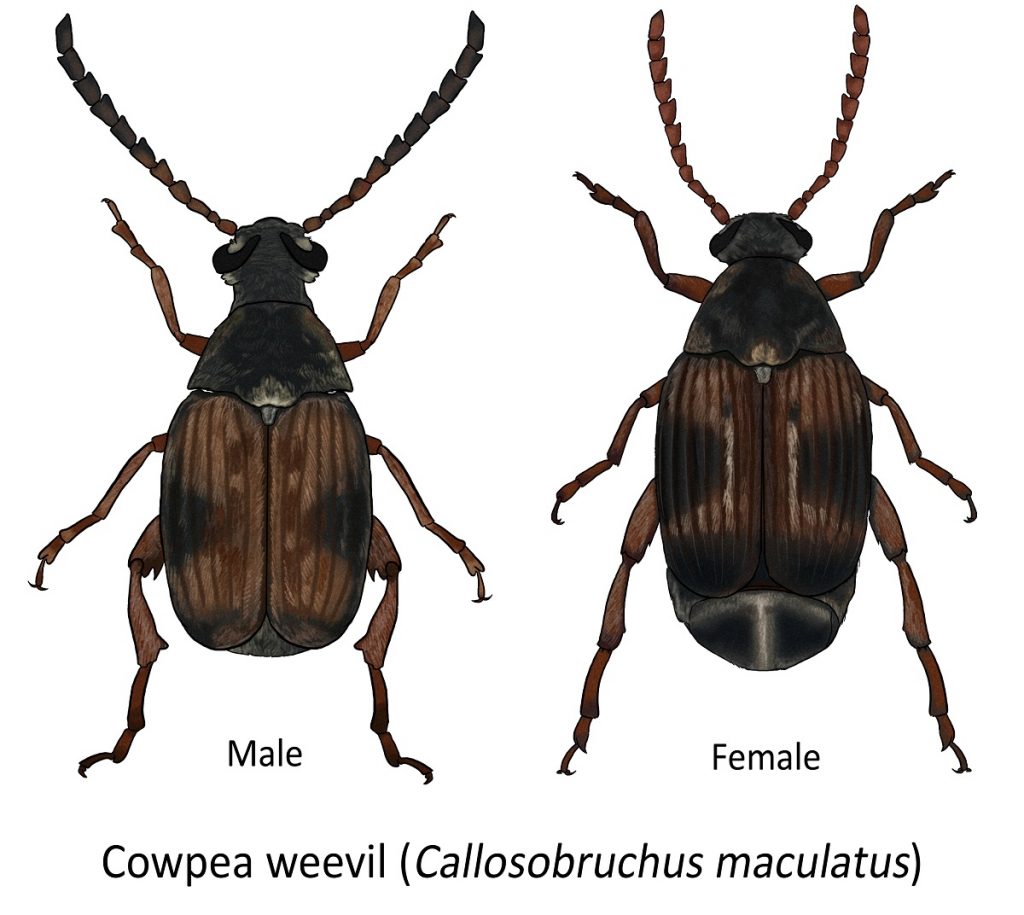
Adult: 3.0-4.0 mm, almond-shaped, long legs and antennae. The elytra do not fully cover the abdomen. Metallic in colour with some pale spots/stripes. The inner ridge of the lower side of each hind femur has one spine.
The female has a bigger abdominal plate at the end with a light longitudinal stripe in the middle, while the male has a smaller and shorter abdominal plate at the end with no markings.
Larva: Scarabeiform, legs are partly developed.
Life Cycle
At optimum conditions of 32 ℃ temperature and 90% relative humidity, the life cycle will be completed in 21 days. The eggs are glued individually to the pod or seed. Once larvae hatch, they bore into seed and complete the development inside.
The adults leave a neat exit hole when they emerge, and do not feed on commodities. The adults are polymorphic and have two morphs, meaning they can either be sedentary or fly. The sedentary morph has a shorter life span and a higher fecundity than the morph that flies. Additionally, the male and female are more easily distinguished in the sedentary morph.
Commodities attacked
Most pulses or legumes, except beans (Phaseolus spp.)
Economic importance
High, especially in bagged and stored beans in tropical and warm temperate regions which can cause heating and lead to mould growth.