Nasutitermes magnus
Distribution
East coast of Australia from Grafton on thee northern coast of New South Wales to Crains in Queensland.
Identification
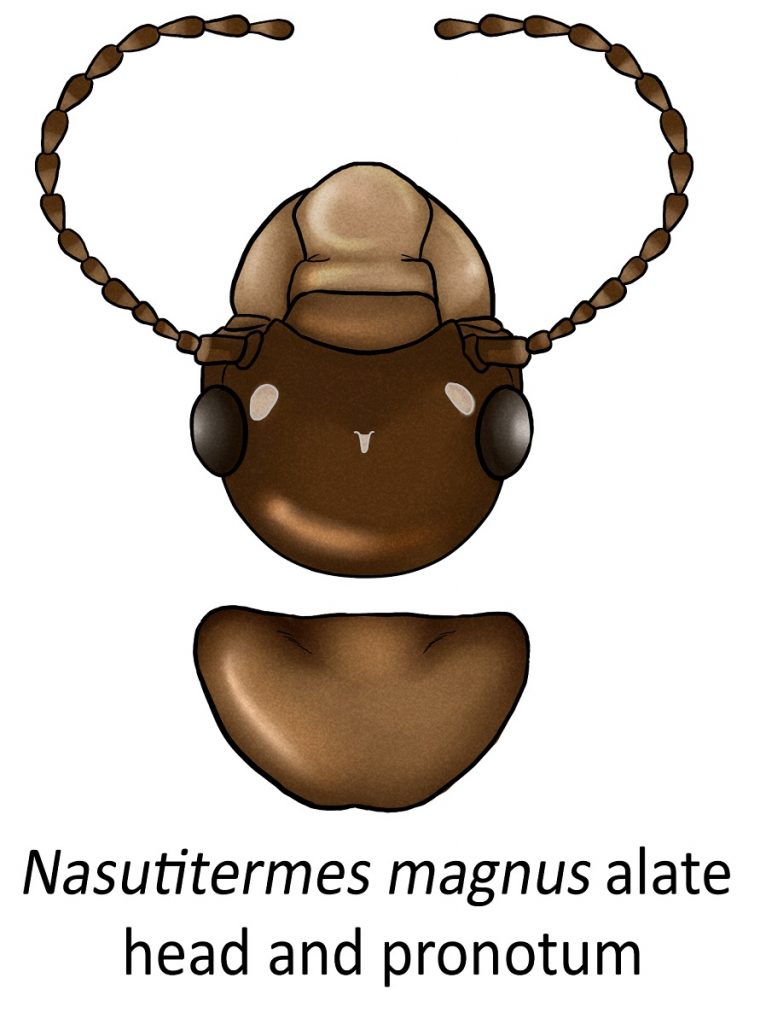
Alate: 19.00–24.00 mm long with wings; 10.00–12.00 mm in length without wings. One of the largest species.
- Head is very large and hairy, and dark brown in colour.
- Postclypeus and pronotum are much paler.
- Legs and antennae are paler than pronotum.
- Wings are light brown; cubitus with 12 branches.
- Fontanelle is small but distinct.
- Antennae have 16 segments; 3rd segment usually a bit longer than the 2nd and 4th segment.
- First and second teeth of right mandible are almost the same size.
Worker: 5.00–6.00 mm in length.
- Head iss brown or mummy brown above and on the sides.
- Genae and postclypeus are cream coloured.
- Antennae have 15 segments; 2nd segment shorter than 3rd; 4th segment longer than 3rd; or 2nd to 4th segments are equal in length.
- Postclypeus is about half as long as wide
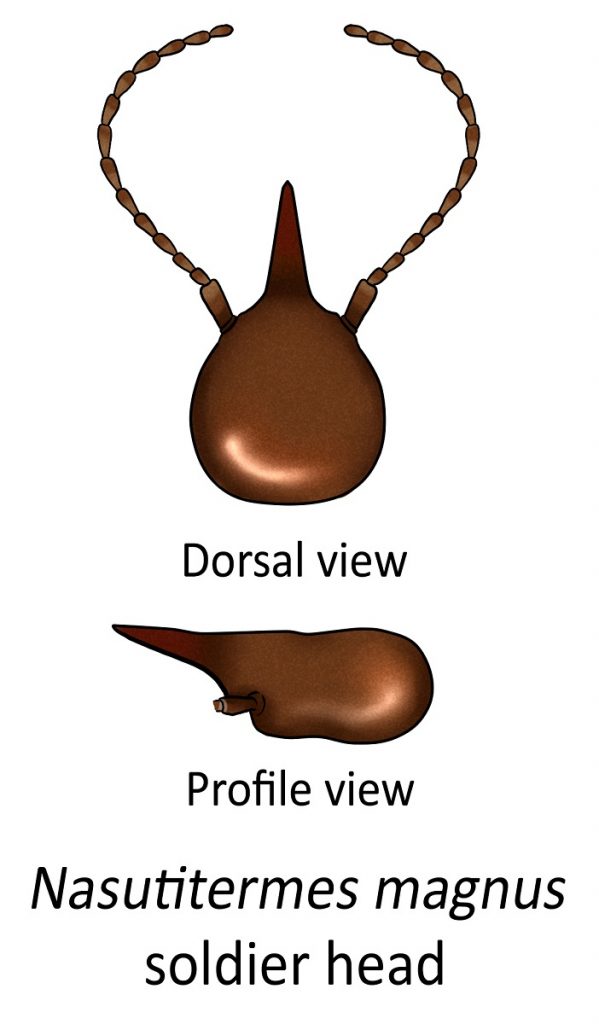
Soldier: 5.00–6.00 mm in length; large to medium in size.
- Head is dark chestnut brown
- A quarter of the rostrum’s base is usually darkest, and the apical three-fourthds is dark reddish-brown.
- Antennae, pronotum, and top surface of abdomen are dark brown.
- Head and abdomen has many stout hairs.
- Antennae have 14 segments; segments are long and narrow. The 3rd segment is equal to or a bit longer than the 2nd; 4th segment always longer than 3rd and 5th; 5th usually longer than 3rd.
- Mandibles with ling, slender points.
Habitat and Behaviour
The nests are not usually in contact with timber, but can be found encircling the base of fence posts, dead trees, or against logs, where glass is not closely cut. It makes low dome-shaped nests with loamy materials with irregulary shaped galleries that encloses a well defined nursery around 36.00 cm in diameter. The outermost galleries are made up of chaffed grass, grass seeds, and seeds of small herbaceous plants.
The nest can be found in various environments but mostly in stiff loamy soils, on treeless plains, or well-grassed open savannahs. They can also be found in stony or sandy ridges and sandly loam.