Scorpions
Scorpions belong to the arachnid order, Scorpiones. They are easily recognizable by their long pedipalps modified into pincers used for grabbing prey and their long narrow tail that bears a telson – a venom container with a curved stinger. They have four pairs of legs and have 6–12 eyes but do not have good eyesight. However, they are able to differentiate light from dark and they have great low light sensitivity enabling them to navigate at night using shadows cast by starlight.
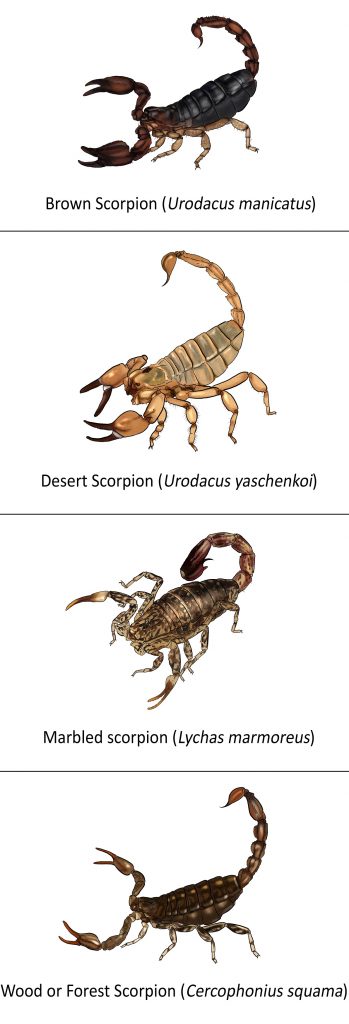
The most commonly encountered scorpion species are; Brown Scorpion (Urodacus manicatus), Desert Scorpion (Urodacus yaschenkoi), Marbled Scorpion (Lychas marmoreus), and Wood or Forest Scorpion (Cercophonius squama).
Distribution and Habitat
They are widespread in Australia and are commonly found in gardens and forests. They usually dwell under logs, rocks, and shallow burrows. They are also species that live in the desert that make deep spiral burrows in the sand.
Feeding habits
Scorpions are nocturnal hunters and feed on insects, other arthropods, and sometimes even small mice or lizards. Once they have sensed a prey, they grab it with their pincers, and then the scorpion stings or crushes it. The scorpion breaks apart its prey with its jaws while also pouring digestive juices onto the prey.
Danger and Health Risks
Although scorpions are regarded as dangerous animals because of their intimidating appearance and venomous tails, out of the 1,750 species of scorpions worldwide, only 25 are considered lethal. Fortunately, most scorpion species in Australia are harmless and there is only one death recorded due to scorpion stings. However, since Australian scorpions can give painful stings that can cause inflammation and pain for several hours, one should still be cautious to avoid being stung.