Greenwood Longicorn
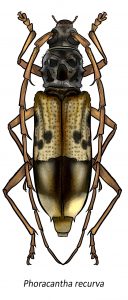
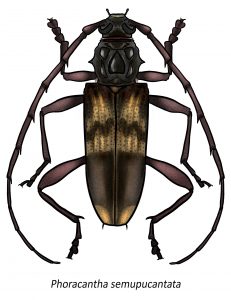
Longicorns or longhorn beetles belong to the Family Cerambycidae. They are easily distinguishable by their elongated bodies that measure from 5 mm to over 70 mm, and long antennae just above their kidney shaped eyes. There are over 33,000 species of longicorns around the world, and Australia has about 1400 species. Along the coast of Eastern Australia, the yellow longicorn Phoracantha recurva and the common eucalypt longicorn Phoracantha semupunctata can be found under the bark of logs and damaged trees
Biology and Behaviour
Female longicorns lay eggs in the phloem-cambial region of felled timber and injured trees. There, the larvae would hatch from the eggs and feed on the phloem, and later penetrate the sapwood, where they would pupate. Most species complete their life cycle in 6–12 months, while some species that up to 3 years.
Although greenwood longicorns are usually forest pests or ornamental tree pests, sometimes they are carried into buildings when they enter the sapwood for pupation and go undetected. After 6 months, they emerge as adults and leave large holes in the walls of homes and buildings. They do not reinfest felled logs once it dries up, or seasoned timber since they require moist bark for laying eggs and moist phloem–cambium for larval development.
Best Treatment
Early application of insecticide sprays in forests and mill yards can prevent longicorn larvae damage. Removal of the bark can also be beneficial since larvae cannot survive and penetrate the sapwood. Larvae feeding degrades the wood’s appearance but since they do not reinfest drywood, no treatment is required.
Leave a Reply