Family Termitidae
This is the largest family of termites known as “higher termites”. They are evolutionarily the most advanced termite family because their guts have a high capacity to degrade plant biomass — this enables them to feed on not only wood, but also grass, leaf litter, lichen, feces, humus, and soil, unlike other families or “lower termites” that have diets restricted to wood.
Members of this family are characterized by 4 tarsal segments, 2 segmented cerci, fontanelle, and saddle-shaped pronotums with anterior lobes.
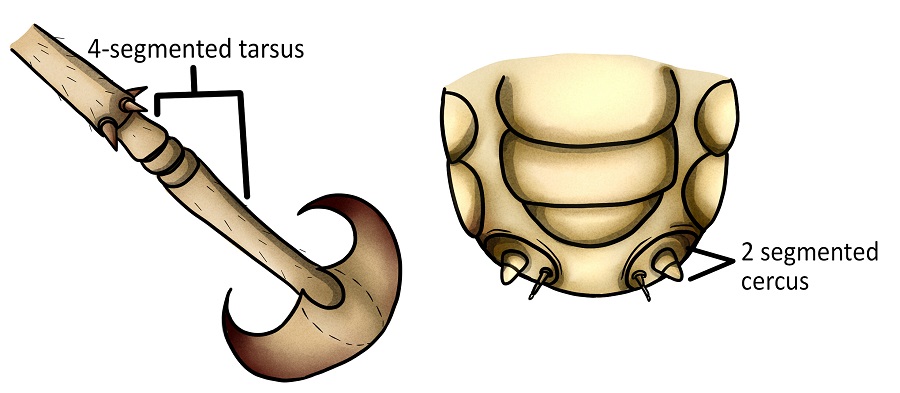
Genus: Microcerotermes
There are 14 species of Microcerotermes in Australia. Some species in this genus only build subterranean nests, however, the species found in Queensland, Microcerotermes turneri and Microcerotermes serratus may build small mounds, underground nests, arboreal nests, or pole nests.
Identification
Soldiers in this genus are 3.25–7.75 mm in length. They have long rectangular heads and long thin mandibles that have serrations when viewed under the microscope.
Microcerotermes is a difficult genus to identify species because of the lack of good characters except for the soldier caste. There are a lot of synonyms in this group — meaning taxonomists were quite uncertain about the placement of the species, so they moved them around a lot. That is why it is often a specialist job to identify termites at a species level.
A guide to identifying M. turneri and M. serratus can be found below
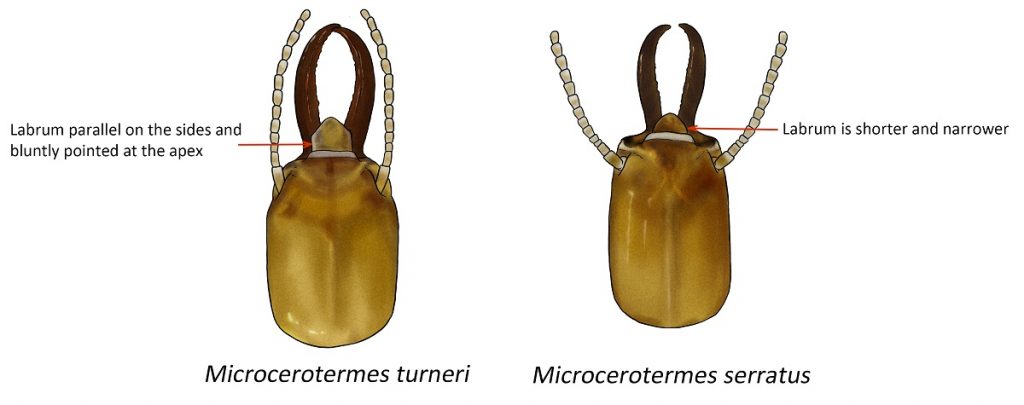
Microcerotermes Species
Microcerotermes turneri
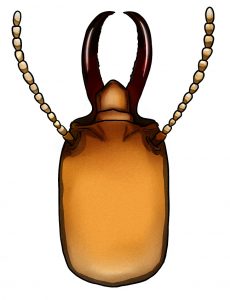
Microcerotermes serratus
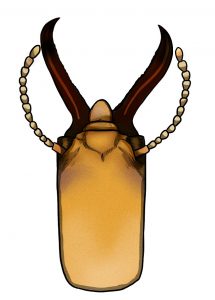
Habitat and Behaviour
M. turneri and M. serratus can be found in dense hardwood forests, timbered grasslands, rainforests, and coastal lowlands. They may build small mounds, arboreal nests, pole nests, and subterranean nests. They attack mostly decaying wood and wood structures that are in contact with the ground such as the base of poles, posts, and fences. The composition of their nests is variable; some nests have hard, woody exteriors that are hard to break up, and some nests have fragile exteriors that can be easily destroyed. Since they build mounds and nests on poles and trees, their activities are easily detected and controlled.M. turneri and M. serratus have little economic importance, nevertheless it has done considerable damage locally to posts, poles, fences, and other wood structures.