Bark Beetles
Bark beetles belong to the subfamily Scolytinae. They are very small beetles about the size of a grain of rice, so identification often needs the aid of a microscope. They have cylindrical bodies, and when viewed from above, their heads are partly or completely hidden beneath the pronotum. They have elbowed antennae that look like clubs, and strong mandibles used for chewing.
Bark beetles are forest pests, however, it is important for technicians to be able to tell bark beetle damage if they occur in buildings since the larvae of some species attack and damage sapwood.
Biology and Behaviour of Common Species
Females lay their eggs in the bark and larvae feed on the phloem–cambial region of trees. They then enter the sapwood to pupate, and after pupation, adults emerge through round flight holes. The life cycle takes about a year to complete but some species may take about two years.
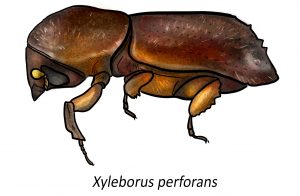
The most common species encountered in Australia is the island pinhole borer or Xyleborus perforans, which attacks ‘pacific maples’ that enter ports. This species only attacks sapwood, and its damage resembles that of the pinhole borer but the holes are not stained. This species carries a fungus and infested growing trees may show signs of wilting, branch die-back, chronic debilitation, sun scorch, or a general decline in vigour. Bark beetle damage is also sometimes confused with that of the powderpost beetle.
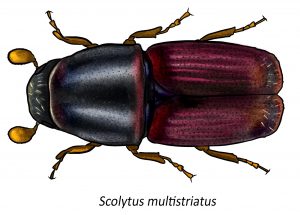
Scolytus multistriatus, the European elm bark beetle carries the fungus Ophiostoma ulmi which causes leaves to wilt, droop and curl and eventually, the tree dies within one or two seasons.
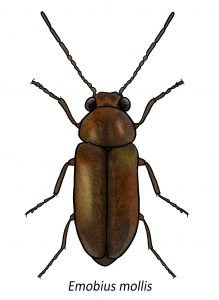
Ernobius mollis, commonly known as the pine bark anobiid, belongs to one of the wood-boring beetle families, Anobiidae. This species attacks radiata pine, but once the bark is removed they do not attack the logs. However, when logs having bark adhering are cut and made into furniture, the emergence of adults through flight holes will leave a bad appearance.
Best Treatment
No treatment is required for the island pinhole borer since it does not survive in drywood. The pine bark anobiid can be controlled by fumigation or careful heat treatment of the furniture.
Leave a Reply