Family Kalotermitidae
This family has both drywood and dampwood species. The soldiers have 4 tarsal segments, and 2 segmented cerci. They do not have a fontanelle (opening of the frontal gland that looks like a hole on their “forehead” used to squirt a white sticky substance as a defense mechanism). They have pronotums that are as wide as their heads.
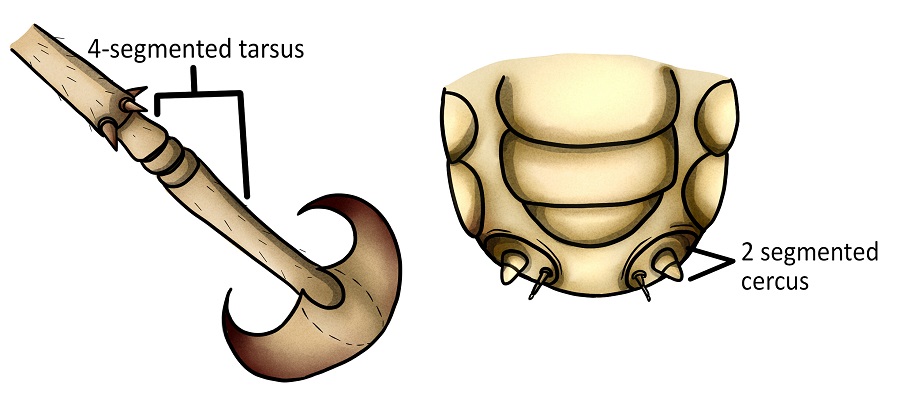
Genus: Neotermes
Scientific name: Neotermes insularis
Common name: Ring-ant termite
Distribution
The species is found in forests of Victoria, New South Wales, Queensland, and Darwin
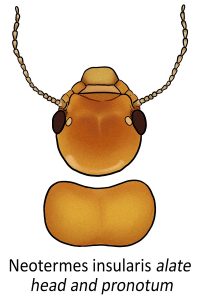
Identification
Alates. This species has large to very large alates measuring 14.50–23,50 mm with wings, and 7.50–12.50 mm without wings.
- Topside of body reddish brown in colour, underside is yellowish
- Eyes and ocelli large
- Pronotum wider than long, always wider than head
- Wings long and narrow
- Veins of wings are brown and always darker than the membrane
- Wing membrane is variable in colour, it may be translucent or light brown
- Tibial spur formula 3-3-3
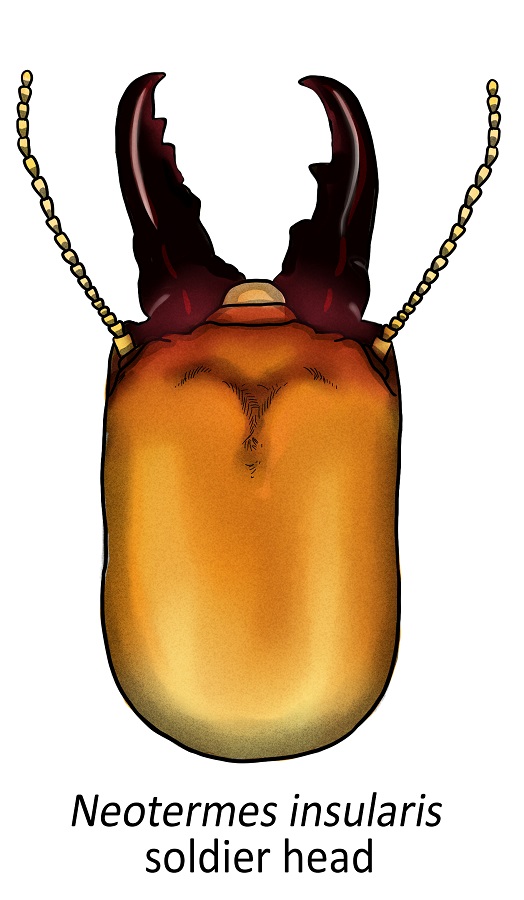
Soldier. Soldiers are 9.0–15.0 mm long
- Head is reddish brown
- Mandibles are black
- Pronotum is yellow and is much wider than long; always wider than head
- Abdomen and legs yellowish
- Head is much longer than wide, with parallel sides
- Mandibles are long and stout; width and serrations are variable
- Tibial spurs 3-3-3
They are sometimes mistaken as Porotermes adamsoni since they are both dampwood termites, and the smaller soldiers of N. insularis is sometimes as big as the soldiers of P. adamsoni. However, they can be differentiated by a few characteristics.
- N. insularis has mandibles that slightly curve upwards when viewed from the side, while P. adamsoni mandibles are rather straight.
- N. insularis has a pronotum as wide as its heads, while P. adamsoni has a narrower pronotum
- N. insularis has clean workings in trees, while P. adamsoni has muddy workings.
Habitat and Behaviour
This species is a major pest of forests on the east coast of Australia, where they degrade trees and make them no longer useful for commercial use. They have a preference for eucalypt trees. They make multiple galleries in the softer growth rings of trees — which is how the species got its common name, ‘ring-ant’ termite. The colony population of ring-ant termites is typically bigger than other dampwood termite species.
Leave a Reply