Heterotermes ferox
Several species of Heterotermes occur in Australia, but Heterotermes ferox is the most common one.
Distribution
H. ferox occurs in Southern Queensland, New South Wales, South, and Southwestern Australia.
Identification
in the genus because of their very dark colour, the soldier caste, on the other hand, is often indistinguishable from other Heterotermes species, specifically H. paradoxus, and H. intermedius.
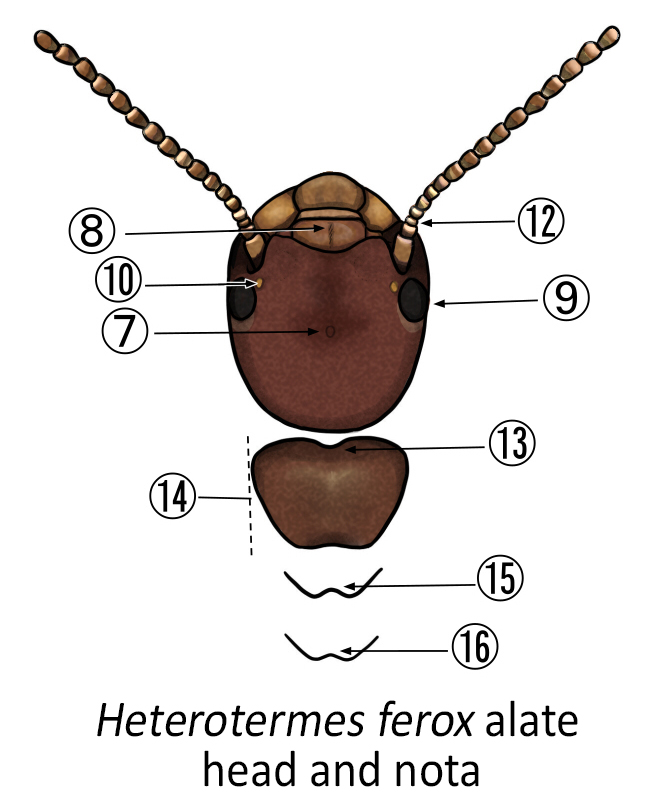
Alates. Alates are about 9.75–11.50 mm in length with wings, and 4.00–5.00 mm without wings.
- They are small in size and dark brown in colour
- Antennae are a little dark brown
- palpi, postcylpeus, and femora are paler than antennae
- Apical part of tibiae and tarsi are cream in colour
- Wings are brownish-grey
- Head longer than wide
- Fontanelle very small but distinct
- Postclypeus small and moderately convexed
- Eyes are small (0.22 – 0.25mm diameter)
- Ocelli very small and variable in shape and size; may be near or separated with the eyes
- Antennae 15–17 segments
- 3rd antennal segment usually the smallest of all
- Pronotum strongly convex, deeply notched anteriorly
- Pronotum sides narrow to the posterior margin
- Posterior margin of mesonotum deeply notched in the middle
- Posterior margin of metanotum less deeply notched and more wavy
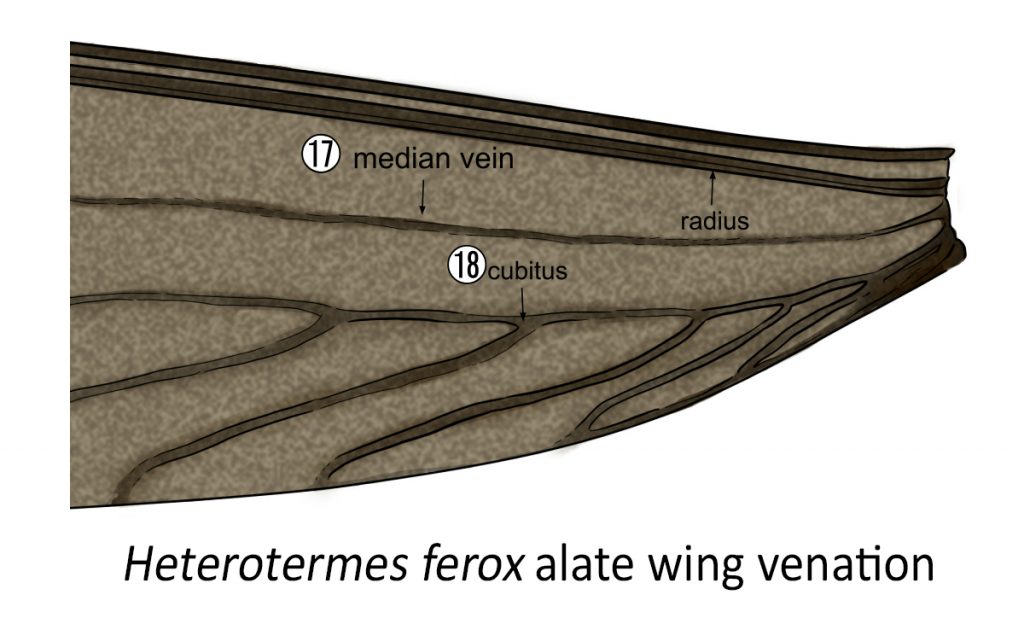
- Median vein of the forewing simple, sometimes with 1 or 2 branches; median vein nearer to the cubitus than to the radius, or equidistant
- Cubitus with 9–11 branches
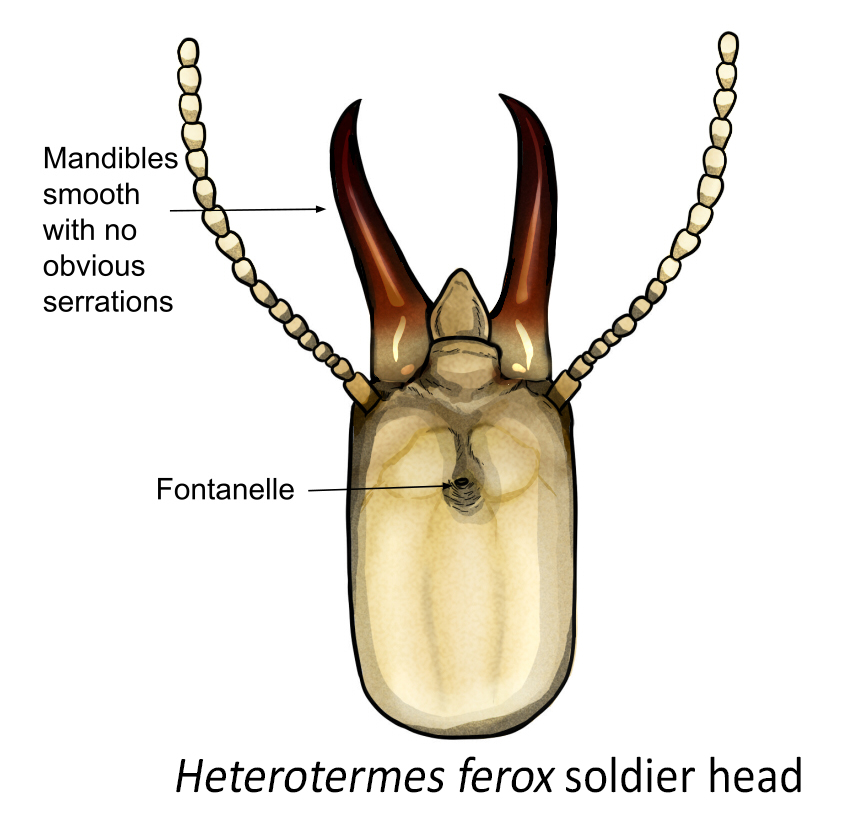
Soldiers. Soldiers measure about 3.75–5.50 mm. They are very variable in size.
They are usually hard to distinguish from the other species in the genus. Antennae have 15-17 segments, and segmentation is very variable. The anterior
Habitat and Behaviour
Species in this genus do not build mounds. They build small colonies near nests of other termite species. They often attack decking, flooring, posts, and fencing, where the timber has contact with the soil, and where some decay is present.
It is possible for the species of this genus to do major damage, but since they only form small colonies, it will take them a very long time. Therefore, they are not considered major pests and have little economic importance.
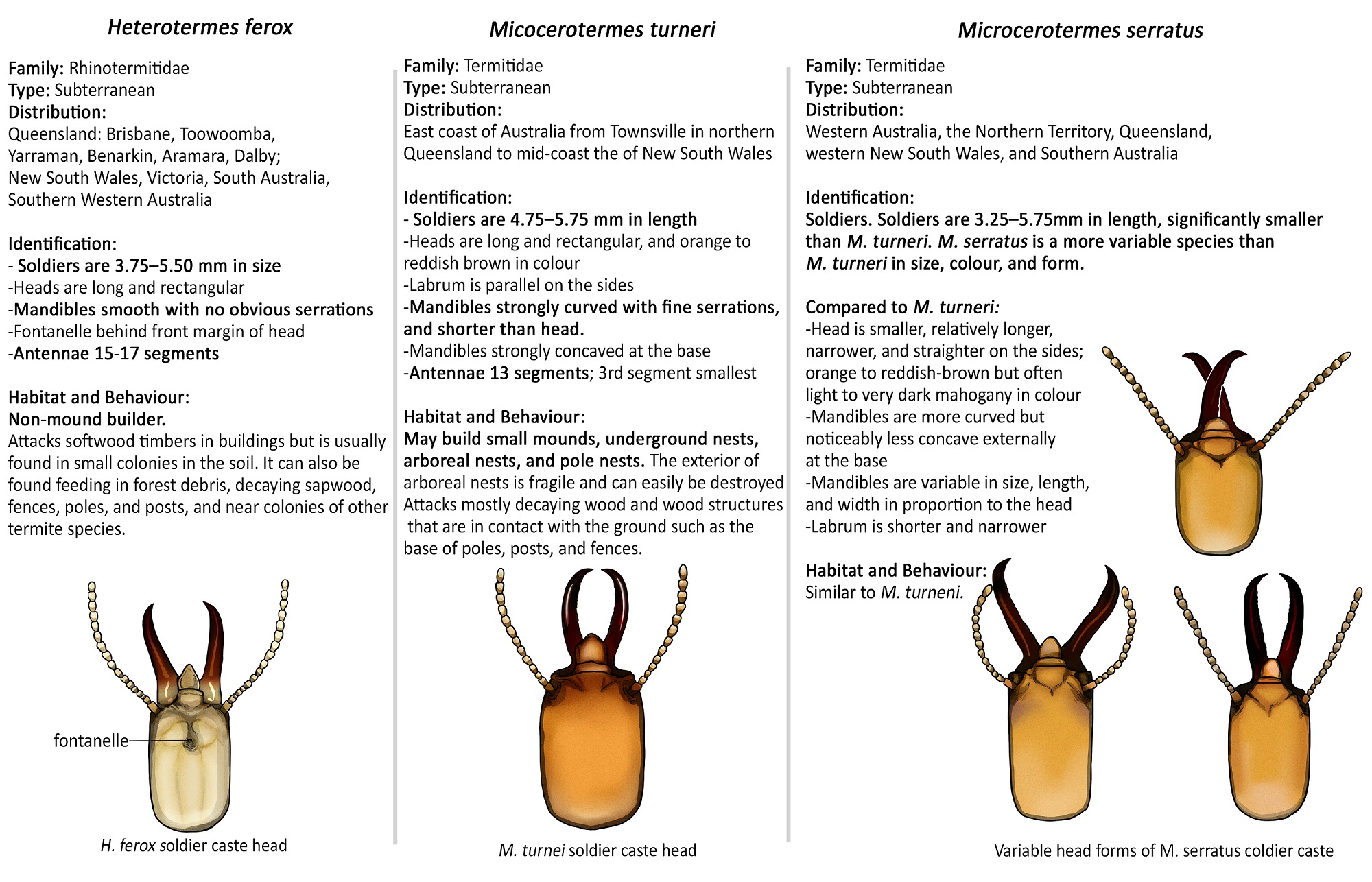
Comparison between Heterotermes ferox, Microcerotermes turneri, and Microcerotermes serratus
Leave a Reply