Flies, mosquitoes, gnats, and midges
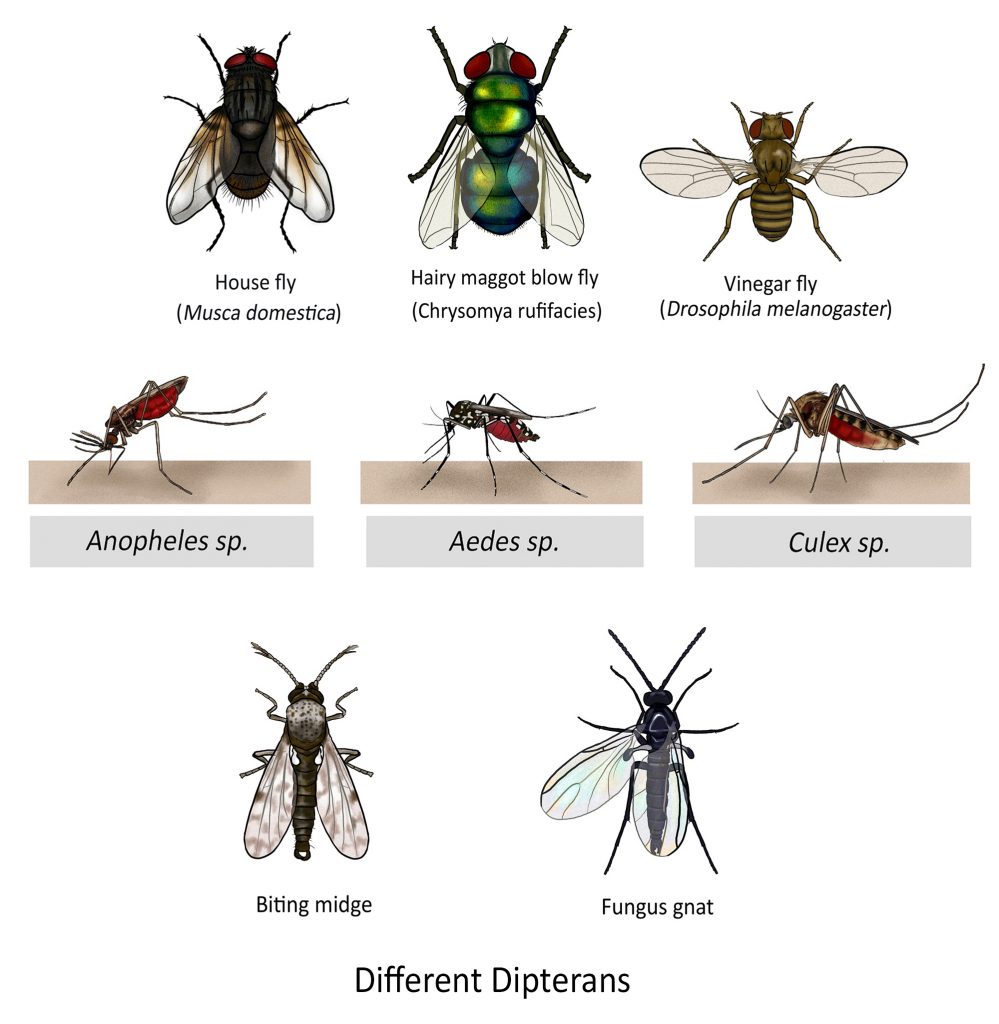
There are about 150,000 described Dipterans in the world, 7,786 of which are present in Australia.
Many believe that dipterans, or true flies, are aeronautical experts, excelling in hovering, barrel-rolls, landings, and even aerial copulation. Surprisingly, there flies have honed these skills by specialising and removing one pair of wings.
Appearance
Adult dipterans are generally small to medium size, featuring a distinctive wing structure. With the exception of a few wingless types, they typically have a single pair of membranous wings, with hindwings replaced by club-shaped balancing organs called halteres. These insects often have large compound eyes, three ocelli, and small bristle-like antennae called aristae. Their body forms vary and are frequently covered in bristle-like hairs. They mainly have sucking mouthparts adapted for rasping, piercing, or sponging.
Larvae resembling maggots are legless and equipped with chewing or modified chewing mouthparts.
Biology and Behaviour
In dipterans, adults and larvae usually inhibit different environments. Adults, with a brief lifespan of weeks, feed on nectar, sap, liquids in decomposing organic matter, or blood in some cases, while some do not feed.
Reproduction is sexual and involves rituals, often in-flight courtship and mating. The eggs of live young are laid on or in larval food ranging from moist environments like stagnant water to decaying matter. Larvae moult while feeding, then move to drier areas to pupate, usually enclosed in a puparium. Adults emerge within days to a week after pupation.
Pest Status
The insect order contains species beneficial for pollination and biological control on other insects, but certain dipterans, like houseflies and mosquitoes, pose significant public health risks due to their potential for disease transmission. Blood-feeding varieties can act as vectors for human diseases such as malaria, while scavenging flies may carry various illnesses. Some flies also cause problems in fruit and vegetable production, and others act as internal parasites in livestock.