Lacewings
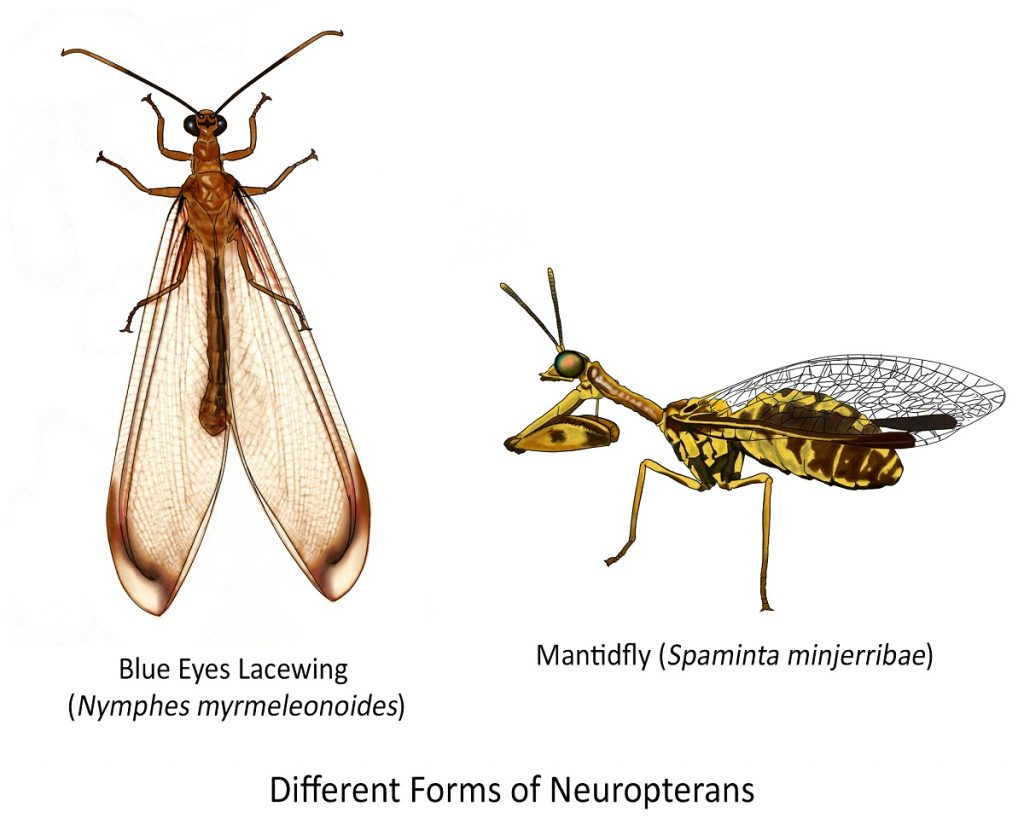
There are over 5,000 species of Neuroptera in the world, 551 of which are present in Australia.
From their common name, lacewings are slender, delicate insects with membranous wings with intricate venations. They are beneficial predatory insects that eat aphids.
Appearance
Adults are small to large, with soft bodies and two pairs of wings with lace-like venation. The forewings are about twice the size of the hindwings. They have slender antennae, prominent compound eyes, and mandibulate mouthparts while lacking cerci. The larvae exhibit diverse structures, usually featuring a defined head capsule with chewing mouthparts and a long body often covered with tubercles or hairs.
Biology and Behaviour
Adult lacewings are mostly nocturnal and are not strong flyers. They prey on small insects but also consume pollen, nectar, or honeydew. Larvae, like antlions, create conical pit traps in fine sandy spoils to capture ants and other small insects. Lacewings reproduce sexually, with eggs laid in soil or on surfaces. After moulting, the larva forms a silken cocoon for pupation, leading to the emergence of winged adults.
Pest Status
This group is not a pest and is beneficial.