Stick and leaf insects
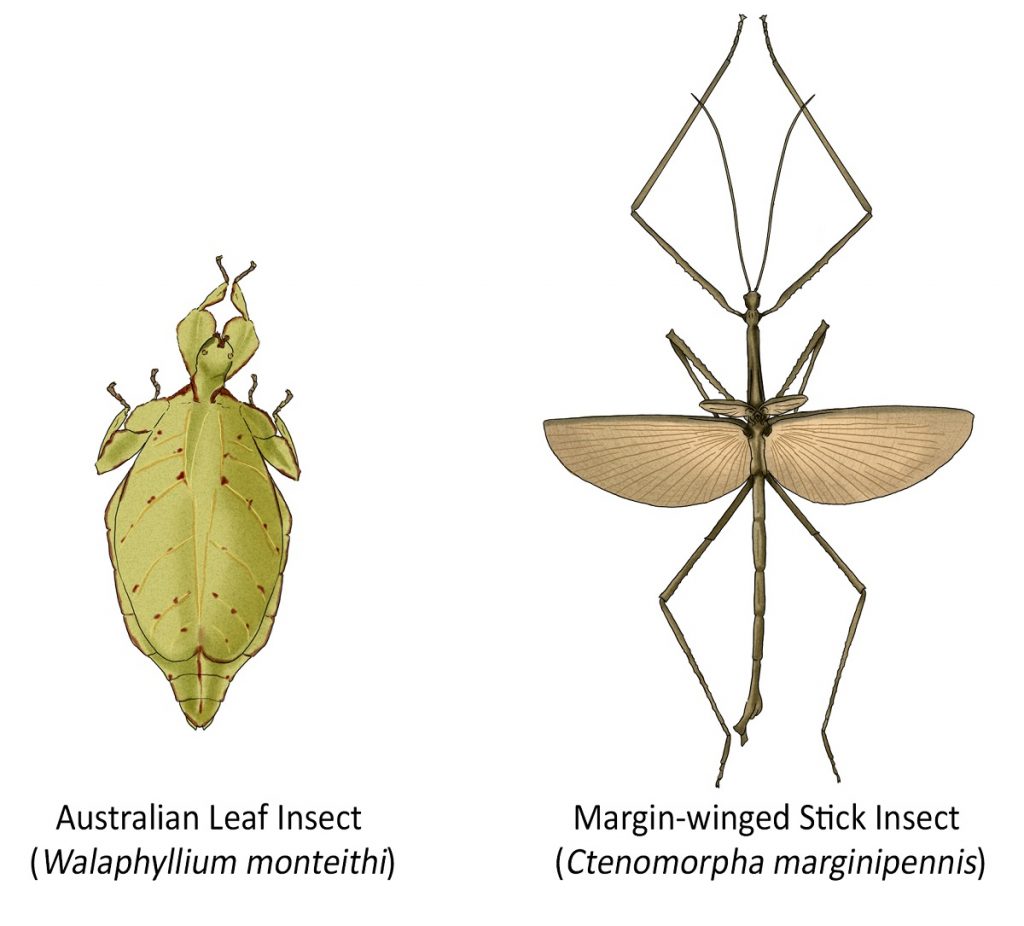
There are more than 3,000 species of stick insects in the world. In Australia, there are 150 species present. As their common name suggests, this group of insects are highly camouflaged and mimic sticks or leaves (leaf insect) to escape predation.
Appearance
Adults are typically medium to very large, with either cylindrical or leaf-like bodies that mimic vegetation. They have short to long, slender antennae, relatively small compound eyes, and often three ocelli in winged species. In Australia, most stick insects are wingless, but if present, wings are fully functional in males and reduced in females, showing short thickened forewings and larger fan-shade membranous hindwings.
Biology and Behaviour
Stick and leaf insects are mainly solitary. They can be seen feeding on trees and shrubs at night and remaining motionless during the day, when disturbed, they often drop to the ground and stay still. They are slow and sometimes clumsy movement characterises them. While some reproduce parthenogenetically or asexually, most undergo sexual reproduction. Females typically lay hundreds to over thousands of eggs, attaching them to vegetation of dropping them to the ground. The nymphs undergo several moults and have similar habits to the adults.
Pest Status
A few species of stick insects can overpopulate the forest and cause serious damage, but they are generally not regarded as pests.